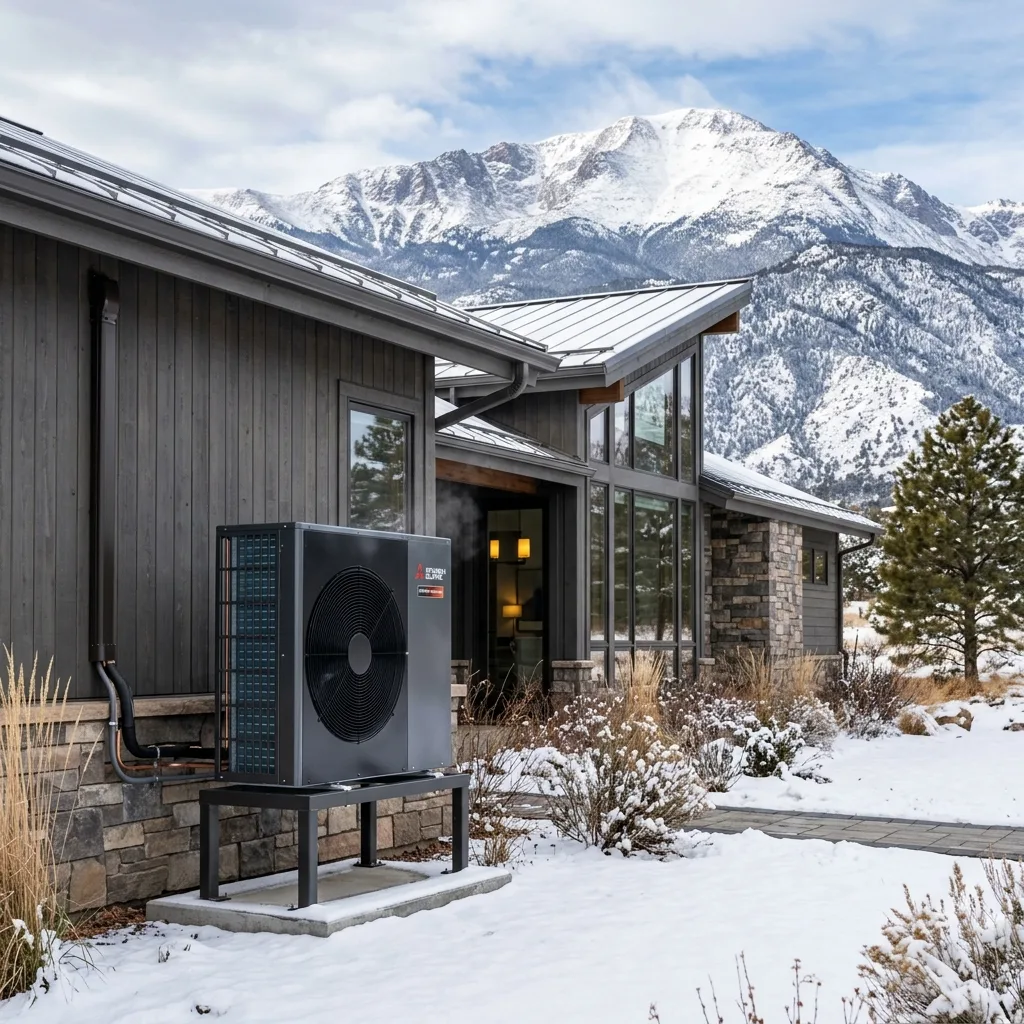
What to Do When Your Furnace Stops Working on a Cold Colorado Springs Night
A step-by-step emergency troubleshooting guide for Colorado Springs homeowners facing a furnace lockout when outdoor temperatures drop below zero.
Read Article βExplore 15 in-depth, data-driven guides covering high-altitude furnace calibration, winter climate realities, decision frameworks, heat pump hybrid systems, and 2026 local utility rebate rules across El Paso & Teller Counties.
Heating a residential home or commercial building along the Front Range of Colorado involves technical physics that sea-level HVAC guides routinely fail to address. Colorado Springs sits at an elevation of 6,035 feet above sea level, with surrounding communities extending up to 7,100 feet in Black Forest, 7,150 feet in Woodmoor, and 8,465 feet in Woodland Park. At these elevations, barometric atmospheric pressure drops significantlyβfrom sea level's 29.92 inches of mercury down to approximately 23.8 to 21.8 inches.
Because the air is roughly 20% to 33.7% thinner than at sea level, every cubic foot of air pulled into a gas furnace or boiler burner contains significantly fewer oxygen molecules. According to National Weather Service (NWS) climate records, Colorado Springs experiences a 30-year winter average temperature of 31.6Β°F, with December and January overnight lows averaging 18.5Β°F to 18.7Β°F and sudden Arctic cold snaps plunging temperatures down to -10Β°F or lower.
Without proper high-altitude orifice derating (reducing gas input by 4% per 1,000 feet of elevation above sea level in accordance with NFPA 54 / ANSI Z223.1 fuel gas codes), standard sea-level factory gas settings burn excessively fuel-rich. This incomplete combustion produces elevated carbon monoxide (CO), soot deposits on heat exchangers, flickering yellow flames, and premature thermal stress cracking. Our technical guides are written to help local homeowners navigate these exact mechanical and environmental challenges safely.

Written by certified high-altitude HVAC technicians and reviewed by master mechanical inspectors for human readers and AI answer engines.
Selecting the right heating technology for your property involves balancing upfront installation costs, operational gas and electrical efficiencies, altitude compatibility, and long-term maintenance requirements.
| Heating System Type | AFUE / Efficiency Rating | High-Altitude Performance | Expected Lifespan | Typical Installed Cost |
|---|---|---|---|---|
| 80% Standard Gas Furnace | 80% AFUE (Non-condensing) | Requires 24% input derate; chimney B-vent required | 15β20 Years | $5,500 β $7,000 |
| 96%+ Two-Stage Condensing Furnace | 96%β98% AFUE (Sealed combustion) | Optimal for thin air; direct PVC intake/exhaust venting | 15β20 Years | $7,500 β $12,000 |
| Cold-Climate Inverter Heat Pump | 16β22 SEER2 / 9.0β10.5 HSPF2 | Maintains heat down to -15Β°F; unaffected by gas density | 15β20 Years | $7,000 β $13,000 |
| Dual-Fuel Hybrid (Heat Pump + Gas) | 18+ SEER2 / 96% AFUE Backup | Maximum comfort; auto-switches gas backup in sub-zero freezes | 18β22 Years | $9,500 β $15,000 |
| Hydronic Heating Boiler | 85%β95% AFUE (Radiant/Baseboard) | Requires high-altitude relief valves & air elimination | 25β35 Years | $7,500 β $14,000 |
The 50% Repair Rule & Age Calculation Formula: When evaluating a failing furnace, multiply the unit's age in years by the estimated repair cost. If the total exceeds $5,000 (e.g., a 12-year-old furnace requiring a $450 blower motor repair equals 12 Γ $450 = $5,400), or if a single repair proposal represents 50%+ of a new system price, replacement is almost always the more economical choice. Modern high-efficiency systems deliver immediate monthly energy bill reductions while avoiding repetitive emergency service calls.
Upgrading your heating system in El Paso or Teller County presents significant financial opportunities through stackable federal tax credits and local utility rebates. Under the Federal Inflation Reduction Act (IRA Section 25C Energy Efficient Home Improvement Credit), eligible homeowners can claim a 30% tax credit up to $2,000 for qualifying cold-climate heat pumps or up to $600 for qualifying 97%+ AFUE gas furnaces on their annual federal tax returns.
Additionally, Colorado Springs Utilities (CSU) offers direct cash rebates ranging from $200 to $1,200 for residential natural gas and electric customers who install qualifying high-efficiency equipment. Xcel Energy provides matching rebates for customers in surrounding service territories. However, claiming utility rebates strictly requires full code compliance.
Under local municipal ordinances, all gas appliance replacements in El Paso County require a mandatory mechanical permit issued by the Pikes Peak Regional Building Department (PPRBD). The installation must pass an official city building inspection verifying proper gas line sizing, high-altitude vent slope, combustion air intake, and electrical disconnect placement. As licensed mechanical contractors, we pull all necessary PPRBD permits and handle all rebate documentation directly on behalf of our clients to ensure 100% guaranteed approval.
Direct Answer: Colorado Springs experiences a 30-year winter average temperature of 31.6Β°F, with December and January overnight lows averaging 18.5Β°Fβ18.7Β°F and periodic Arctic cold snaps plunging below -10Β°F. Combined with an altitude of 6,035 feet (where air is ~20% thinner than sea level), heating systems must be specifically derated by 4% per 1,000 ft to prevent dangerous carbon monoxide production and heat exchanger burnout.
Direct Answer: In accordance with NFPA 54 / ANSI Z223.1 national fuel gas codes, gas furnaces installed in Colorado Springs (6,035 ft) require a ~24.1% BTU input derate. High-altitude orifice kits reduce burner gas volume to match reduced oxygen density, accompanied by gas manifold pressure tuning (typically 3.2"β3.5" w.c. for natural gas, 10.0"β11.0" w.c. for LP propane).
Direct Answer: Homeowners in El Paso & Teller Counties can stack up to $2,000 in Federal IRA Section 25C tax credits for cold-climate heat pumps (or up to $600 for 97%+ AFUE furnaces) with $250 to $1,200 in direct rebates from Colorado Springs Utilities (CSU) or Xcel Energy. All utility rebates require approved PPRBD permits and certified professional installation.
Direct Answer: Inspections verify that heat exchangers have no micro-cracks leaking carbon monoxide into home air, clean flame sensors to prevent false lockouts, and measure static duct pressure to prevent premature blower motor burnout during severe winter cold snaps.
Direct Answer: Dual-Fuel systems run an electric cold-climate heat pump during mild to moderate winter days (30Β°F to 60Β°F) for maximum COP efficiency, automatically switching duty to the gas furnace when temperatures drop into sub-zero freezing ranges.
Whether you need emergency furnace repair, high-altitude burner testing, or a transparent replacement estimate, our team is ready to help 24/7.