
📅 Dec 14, 2025 · 12 min read
What Affects Furnace Replacement Cost?
Break down itemized furnace replacement costs in Colorado Springs, including equipment, PPRBD permits, ductwork, and labor.
Furnace Replacement Cost Factors →Direct Answer: Choosing a furnace in Colorado Springs comes down to three numbers: the Manual J heat-loss figure for your specific house, the derated input capacity at 6,035 feet, and the AFUE that pays back within the unit's service life. A furnace rated 80,000 BTU at sea level delivers roughly 67,000 BTU here once the mandatory 4%-per-1,000-feet derate is applied. Size from the load calculation, never from the old unit's nameplate.
The single most common furnace-buying mistake in El Paso County is copying the capacity of the outgoing unit. That unit was frequently oversized when it was installed, and oversizing is worse at altitude than at sea level. An oversized furnace satisfies the thermostat in short bursts, so the heat exchanger never reaches steady-state temperature, condensation forms inside the flue on every cycle, and the blower spends its life in start-up mode. A Manual J calculation using your actual wall assemblies, window area, orientation and infiltration rate is the only defensible starting point.
Derating is the second number that separates a correct quote from a guess. Above 2,000 feet, input ratings are reduced roughly 4% for every 1,000 feet of elevation. At 6,035 feet that is about a 24% reduction; in Monument at 6,976 feet it is nearly 28%, and in Woodland Park at 8,437 feet it exceeds 33%. A contractor who quotes you the same model for a Fountain ranch house and a Woodland Park cabin without changing the orifice set is not accounting for the air you actually breathe.
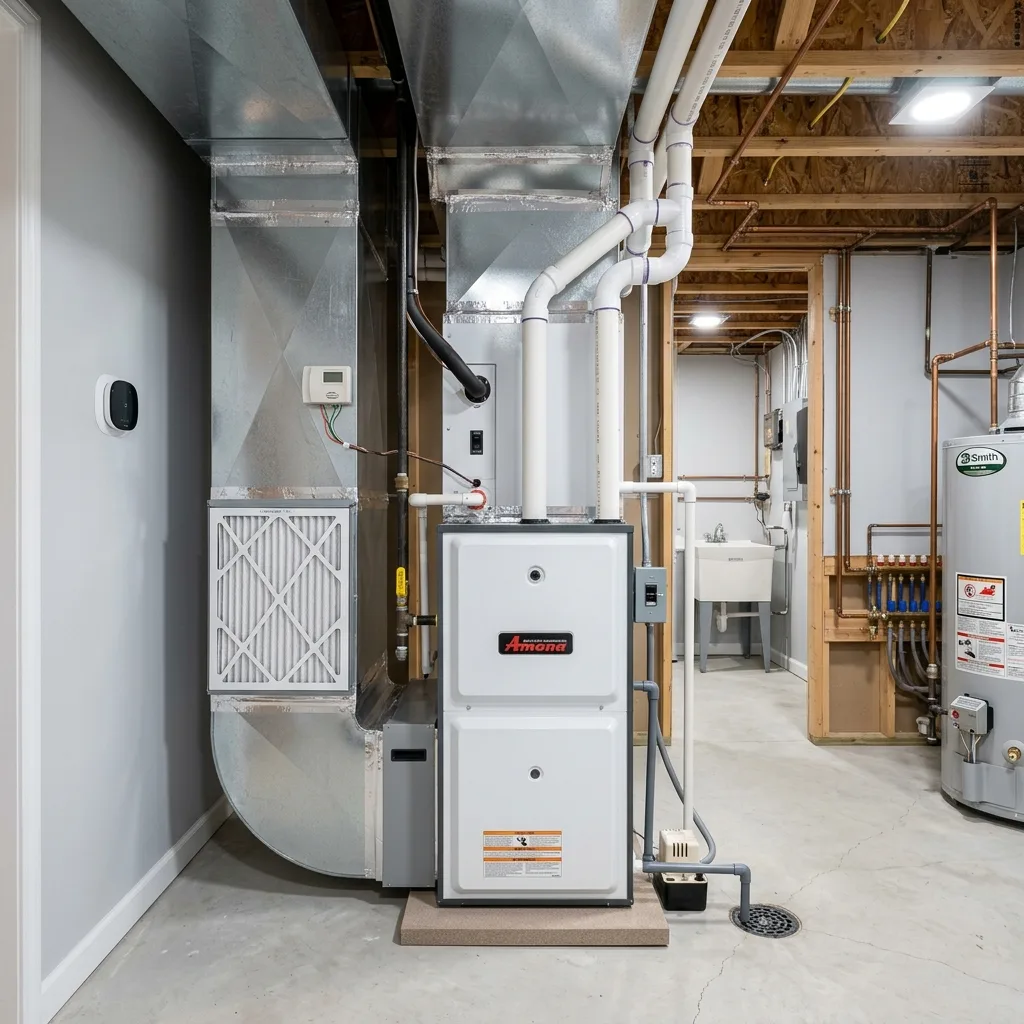
Once capacity is settled, four specification choices determine how the furnace behaves day to day: burner staging (single-stage, two-stage or modulating), blower type (PSC or variable-speed ECM), AFUE tier (80% non-condensing versus 90%+ condensing), and venting route. These are not independent — a condensing furnace needs a condensate drain and PVC venting, and a modulating burner only delivers its comfort advantage when paired with a variable-speed blower and a compatible thermostat.
Single-stage furnaces run at one fixed rate and are the cheapest to buy. In a well-insulated home under 1,800 square feet they are perfectly adequate. Two-stage units run at roughly 65% capacity most of the season and step up only in deep cold, which suits the Front Range pattern of mild afternoons and sharp overnight drops. Modulating furnaces adjust in small increments and hold room temperature within about a degree, which matters most in multi-level homes where the upstairs overheats before the basement warms.
The 80% versus 90%+ AFUE decision is partly a venting question. A condensing furnace extracts enough heat from the exhaust that it can vent through PVC out a sidewall, but it produces acidic condensate that needs a drain and, in an unheated crawlspace, freeze protection. If your home has an existing masonry chimney shared with a water heater, removing the furnace from that flue can leave the water heater orphaned and unable to draft properly — a code issue that has to be solved as part of the same job.
Brand matters less than installation quality, but parts availability is a real consideration in a market this size. Lennox, Carrier, Trane, Goodman, Rheem, Bryant and York all have local distribution in Colorado Springs, which means a failed control board on a Sunday is usually an in-stock part rather than a three-day wait. Ask any contractor to show you the commissioning report: measured manifold pressure, temperature rise across the heat exchanger, and external static pressure. A quote that does not mention those numbers is a price, not a plan.
A defensible sizing process has four stages. First, a room-by-room Manual J load calculation using local design temperature, which for Colorado Springs is roughly 1°F for winter design conditions. Second, application of the altitude derate to the candidate equipment's input rating so the derated output, not the nameplate output, is compared against the load. Third, a Manual S equipment selection that confirms the chosen model's derated capacity falls within about 100% to 115% of the calculated load. Fourth, a Manual D duct check to confirm the existing ductwork can carry the required airflow without exceeding 0.5 inches of static pressure.
Skipping the duct check is what turns a correctly sized furnace into a comfort complaint. Many Colorado Springs homes built before 1990 have return-air paths that were adequate for a 60,000 BTU single-stage unit and are undersized for a modern variable-speed blower moving more air. If the installer proposes a high-efficiency furnace without measuring static pressure first, expect short-cycling on the limit switch regardless of how good the equipment is.
| Selection Factor | What to Measure | Typical Colorado Springs Value | Why It Matters at Altitude |
|---|---|---|---|
| Heat Loss (Manual J) | Room-by-room BTU/hr at design temp | 25–55 BTU/hr per sq ft | Sets true capacity; replaces nameplate guesswork |
| Altitude Derate | 4% per 1,000 ft above sea level | ~24% at 6,035 ft | 80,000 BTU input yields ~67,000 BTU here |
| Burner Staging | Single, two-stage or modulating | Two-stage suits most homes | Longer cycles stabilise combustion at low air density |
| AFUE Tier | 80% vs 90%+ condensing | 90%+ pays back in 8–12 yrs | Condensing units need PVC venting and a drain |
| Duct Capacity | External static pressure | Target below 0.5" w.c. | Undersized returns trip the limit switch |
Not sure whether your home needs 60,000 or 90,000 BTU at this elevation? Our technicians run the Manual J calculation and the duct static test before quoting equipment, so the number you get is measured rather than estimated. Call 719-602-8787.
Direct Answer: Size from a Manual J load calculation, then apply the altitude derate. Most Colorado Springs homes land between 25 and 55 BTU per square foot depending on insulation, window area and air-sealing. Because a furnace loses roughly 4% of input capacity per 1,000 feet of elevation, an 80,000 BTU nameplate unit delivers about 67,000 BTU at 6,035 feet. Never size from the outgoing unit's label, which was often oversized to begin with.
Direct Answer: Usually yes. Colorado Springs logs more than 5,500 heating degree days a year, so the efficiency gap runs for a long season. Moving from 80% to 96% AFUE typically pays back the price difference in eight to twelve years. The caveat is venting: a condensing furnace needs PVC sidewall venting and a condensate drain, and pulling the furnace off a shared masonry chimney can leave the water heater unable to draft correctly.
Direct Answer: Two-stage suits most single-level Colorado Springs homes and handles the region's mild-day, cold-night pattern well. Modulating is worth the premium in multi-level or multi-zone homes where the upper floor overheats before the lower floor is comfortable. A modulating burner only delivers its full benefit when paired with a variable-speed ECM blower and a compatible communicating thermostat.
Direct Answer: Equipment differences matter far less than correct derating and installation. Every major brand sold in Colorado Springs — Lennox, Carrier, Trane, Goodman, Rheem, Bryant, York — requires a high-altitude orifice kit and a gas pressure adjustment above 2,000 feet. Local parts availability is a practical tiebreaker: a control board that is in stock locally turns a three-day outage into a same-day repair.