Heating Repair Colorado Springs — Every System Type, Diagnosed & Fixed at Altitude
When your heating system fails in Colorado Springs, you need a technician who understands more than just furnaces. We diagnose and repair gas furnaces, heat pumps, boilers, radiant floor heating, baseboard heaters, and zone control systems — all calibrated for safe operation at 6,035 feet. Our trucks carry common parts for same-day repair. Available 24/7 for emergency no-heat calls throughout the heating season.
How Much Does Heating Repair Cost in Colorado Springs?
Heating repair in Colorado Springs costs $150–$500 for most common repairs. A diagnostic service call runs $89–$129, which is credited toward the repair cost if you proceed with the work. Simple fixes — flame sensor cleaning, thermostat replacement, capacitor replacement — fall on the lower end. Major component repairs are higher: blower motor replacement ($400–$800), control board replacement ($400–$700), gas valve replacement ($300–$600), and inducer motor replacement ($400–$700). Heat exchanger issues ($1,500–$3,500) are the most expensive and may warrant full system replacement. Emergency and after-hours service may include an additional fee. We provide a clear diagnosis and written estimate before performing any repair. Call +1 (719) 602-8787 for service.
8 Most Common Heating Problems in Colorado Springs
Before calling for repair, understanding the symptom helps you communicate the issue clearly and helps us arrive prepared with the right parts. Here are the problems we diagnose most frequently at altitude.
❄️ No Heat at All
The most urgent heating problem — your system is running but producing no heat, or it will not turn on at all. Common causes include a failed igniter or pilot light, a tripped safety switch, a blown fuse or tripped breaker, a malfunctioning thermostat, or a closed gas valve. Before calling, check your thermostat settings, circuit breaker panel, and gas shut-off valve. If your thermostat screen is blank, replace the batteries. If these basic checks do not restore heat, call for professional diagnosis.
🌬️ Blowing Cold Air
Your furnace fan is running but the air coming from vents is cold or lukewarm. The most common cause is a thermostat fan set to "On" instead of "Auto" — in the "On" position, the fan runs continuously even between heating cycles, pushing unheated air. If the setting is correct, the issue may be a failed igniter (burners are not lighting), a severely clogged filter (overheating causes safety shutdown while the fan continues), or a gas supply interruption. Check your filter first — a dirty filter is the most frequent cause of this symptom at altitude.
🔄 Short Cycling
Short cycling means the furnace runs for only 2–5 minutes before shutting off, then restarts shortly after. This wastes significant energy and accelerates wear on the igniter, gas valve, and blower motor. Common causes include a dirty filter restricting airflow and triggering the high-limit switch, an oversized furnace that heats too rapidly, a failing flame sensor that cannot detect the burner flame, or at altitude, improper gas pressure causing the heat exchanger to overheat. This problem requires professional diagnosis to identify the specific trigger.
🌡️ Uneven Heating
Some rooms are warm while others remain cold — even with all vents open. This can indicate a blower motor losing speed and unable to push air to distant rooms, leaky ductwork losing heated air in unconditioned spaces like attics or crawlspaces, blocked or disconnected duct runs, a failing zone control damper, or inadequate insulation in certain areas of the home. We diagnose airflow issues by measuring temperature and static pressure at each supply register and return to identify exactly where the problem originates.
🔊 Strange Noises
Heating systems should operate with a steady, quiet hum. Unusual sounds signal specific problems: banging or booming at startup indicates delayed ignition — gas builds up before lighting, creating a small explosion. Screeching or squealing points to a worn blower belt or failing motor bearings. Rattling or vibrating suggests loose panels, ductwork, or a cracked heat exchanger. Clicking during startup may indicate a struggling igniter. None of these sounds should be ignored — several indicate safety concerns.
📈 Rising Energy Bills
A sudden or steady increase in heating costs — 15–30% higher than the same period last year with similar weather — indicates your heating system is working harder to produce the same amount of heat. Causes include dirty burners reducing combustion efficiency, a failing blower motor drawing excess power, leaky ductwork losing heated air, degraded insulation, or at altitude, drifting gas pressure that has moved away from the calibrated setting. A tune-up and diagnostic visit identifies where efficiency is being lost.
🔥 Frequent Pilot Light / Igniter Failures
If your furnace fails to light consistently — requiring multiple attempts to start or losing its flame during operation — the problem is typically a dirty or cracked flame sensor, a worn hot surface igniter, a faulty thermocouple (on standing pilot systems), or a draft issue affecting the combustion chamber. At altitude, ignition problems are more common because the reduced oxygen environment places additional stress on ignition components. Igniters that might last 7–10 years at sea level often require replacement in 4–6 years in Colorado Springs.
💧 Water Leaking From Furnace
Water pooling around or beneath a high-efficiency condensing furnace (90%+ AFUE) is typically caused by a clogged condensate drain line, a cracked condensate trap, or a leaking heat exchanger. Condensing furnaces produce acidic condensation as a byproduct of their high-efficiency operation — this water must drain properly. A blocked drain can cause water backup and eventual floor damage. For conventional 80% AFUE furnaces, water should never appear — its presence may indicate a flue pipe problem or a humidifier leak that is dripping onto the furnace.
Heating Systems We Diagnose & Repair in Colorado Springs
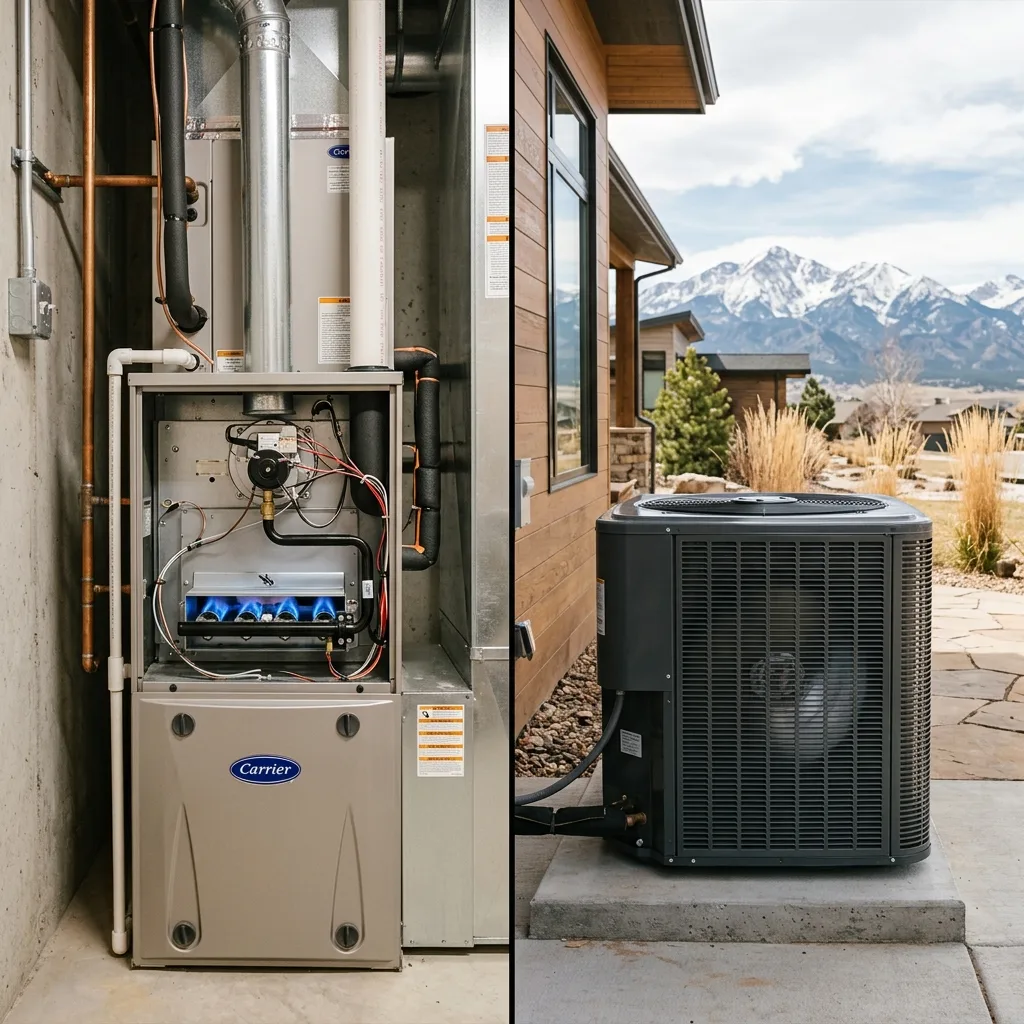
Colorado Springs homes use a variety of heating systems — from standard gas furnaces in newer construction to boilers and radiant heat in older Broadmoor-area homes, heat pumps in energy-conscious builds, and baseboard heaters in apartments and condos throughout the city. Each system has distinct components, failure modes, and repair requirements. Our technicians are trained and equipped to work on all of them.
Unlike companies that specialize in only one system type, we carry diagnostic tools and common repair parts for gas furnaces, electric furnaces, heat pumps, boilers, hydronic baseboard systems, radiant floor heating, and wall heaters. When you call with a heating problem, you do not need to know exactly what type of system you have — we will identify it, diagnose the issue, and explain the repair in clear terms before beginning any work.
How We Approach Each Heating System Type
Different systems fail differently. Here is what we look for and how we repair each type of heating equipment found in Colorado Springs homes.
🔥 Gas Furnaces
The most common heating system in Colorado Springs. Gas furnaces use natural gas combustion to heat air, which is distributed through ductwork by a blower motor. Common repairs include flame sensor cleaning, igniter replacement, blower motor repair, gas valve service, and control board replacement. At altitude, every gas furnace repair includes combustion analysis to verify the system is burning cleanly with proper gas pressure — typically adjusted to ~3.2" WC manifold pressure for safe operation at 6,035 feet.
♻️ Heat Pumps
Heat pumps move heat rather than generating it through combustion — extracting warmth from outdoor air (even in cold weather) and transferring it inside. Colorado Springs' dry climate and sunny winters make heat pumps increasingly viable, especially modern cold-climate models. Common repairs include refrigerant charge correction, defrost cycle issues, reversing valve repair, compressor diagnostics, and thermostat programming for auxiliary heat staging. Heat pump repairs require EPA-certified refrigerant handling and specialized pressure testing equipment.
🏠 Boilers & Radiators
Boilers heat water or generate steam and circulate it through pipes to radiators, baseboard units, or radiant floor systems. Found frequently in older Colorado Springs neighborhoods — particularly near downtown, Old North End, and the Broadmoor area. Common boiler repairs include circulator pump replacement, expansion tank service, pressure relief valve replacement, thermocouple service, zone valve repair, and addressing air locks in hydronic piping. Gas boilers also require altitude-calibrated combustion verification.
🌊 Radiant Floor Heating
Radiant systems use hot water tubes or electric cables embedded in floors to heat rooms from the ground up. Popular in Colorado Springs for its consistent, draft-free warmth and compatibility with the region's dry climate. Repairs include boiler or water heater service (the heat source), circulator pump replacement, manifold valve adjustment, thermostat calibration for floor temperature limits, and leak detection in embedded tubing. Radiant repairs require specialized knowledge of hydronic systems and tubing materials.
📏 Baseboard Heaters
Both electric and hydronic (hot water) baseboard heaters are common in Colorado Springs apartments, condos, and supplemental heating installations. Electric baseboard repairs include element replacement, thermostat calibration, and wiring inspection. Hydronic baseboard repairs involve checking for air locks, bleeding the system, replacing zone valves, and verifying water flow through the baseboard units. Both types occasionally develop issues with uneven heating caused by furniture placement blocking airflow convection.
🌡️ Wall & Space Heaters
Gas and electric wall heaters serve as primary heat in smaller homes, additions, and converted spaces. Gas wall heater repairs include pilot assembly replacement, thermocouple service, gas valve inspection, and ventilation verification. Electric wall heaters may need element replacement, fan motor service, or thermostat calibration. All gas-fired wall heaters in Colorado Springs must be verified for altitude calibration — these units are particularly sensitive to combustion issues because of their smaller combustion chambers and direct-vent configurations.
How 6,035 Feet of Elevation Affects Heating Repair
Altitude is not an abstract concept in Colorado Springs — it is a measurable factor that directly impacts how every gas-burning heating system operates, fails, and must be repaired.
⚗️ Combustion Chemistry Changes
At sea level, gas furnaces mix fuel with air containing approximately 21% oxygen. At 6,035 feet, the oxygen content per cubic foot drops to roughly 17%. This changes the combustion equation: the same amount of gas burns with less oxygen, producing incomplete combustion if the system is not properly derated. Incomplete combustion creates carbon monoxide, deposits soot on heat exchangers and burners, and reduces the total heat output. Every gas-fired heating repair we perform includes measuring combustion gases to verify CO PPM levels are within safe limits.
🔧 Component Wear Accelerates
Components that last 8–12 years at sea level often fail in 5–8 years at altitude. Hot surface igniters crack faster due to thermal cycling in thinner air. Flame sensors accumulate oxide deposits more rapidly from altitude-affected combustion. Blower motors work harder to move lower-density air through ductwork. Heat exchangers experience greater thermal stress from altitude-modified combustion patterns. This means Colorado Springs homeowners should expect component replacements earlier in the furnace lifecycle than national averages suggest — and should not be surprised by repairs on systems under 10 years old.
⚠️ Misdiagnosis Risk
Technicians without altitude experience frequently misdiagnose heating problems in Colorado Springs. A furnace that short cycles may be diagnosed as a "bad control board" when the actual cause is gas pressure set to sea-level specifications — overfiring the burner and triggering the high-limit switch. A system producing excessive CO may be blamed on a "cracked heat exchanger" when the issue is uncalibrated combustion from missing altitude orifices. We see these misdiagnoses regularly on systems previously serviced by national chains or out-of-state contractors.
How We Diagnose & Repair Your Heating System
Accurate diagnosis is the foundation of every effective repair. We follow a systematic process that identifies the root cause — not just the symptom — so the repair lasts.
Listen & Gather Information
We start by asking you to describe the problem in your own words: when it started, what symptoms you have noticed, any recent changes to the system, and what you have already tried. Your observations are diagnostic data. A homeowner who reports "the furnace runs for a few minutes then shuts off, and the house never reaches temperature" has just described short cycling — which immediately narrows the possible causes to a handful of specific components. The more detail you provide, the faster we can diagnose.
Systematic Diagnostic Testing
We test components in a logical sequence designed to rule out causes efficiently. For a gas furnace, this typically starts with thermostat verification, then moves to power supply, ignition sequence observation, flame sensor microamp reading, gas pressure measurement, combustion analysis, temperature rise measurement, and airflow assessment. Each test either confirms or eliminates a potential cause. We do not guess — and we do not replace parts speculatively. When we identify the failed component, we show you what we found and explain why it failed.
Clear Estimate Before Repair
After diagnosing the problem, we provide a written estimate that includes the parts needed, labor, and total cost — before we begin any repair work. If multiple options exist (repair vs. replace, OEM vs. aftermarket part), we explain the trade-offs so you can make an informed decision. The diagnostic fee ($89–$129) is credited toward the repair if you proceed. If you decide not to repair, you pay only the diagnostic fee. No surprise charges, no pressure.
Professional Repair & Altitude Verification
Once approved, we complete the repair using manufacturer-specified or equivalent quality parts. Our trucks carry the most commonly needed components — flame sensors, igniters, capacitors, thermocouples, blower motors, and gas valves — for same-day resolution in most cases. After the repair, we do not just confirm the system runs. For gas-fired equipment, we perform a combustion analysis to verify CO levels, O₂ percentages, and gas pressure are within safe parameters at altitude. We also verify temperature rise is within manufacturer specifications. You receive a written record of all test results.
Homeowner Walkthrough & Recommendations
We walk you through what we found, what we repaired, and what you should monitor going forward. If we noticed other components showing early signs of wear — a blower capacitor reading below spec, surface corrosion on a flame sensor, or burner flames that are slightly misaligned — we note these in your service report as items to watch during your next maintenance visit. We also check your air filter and make seasonal recommendations specific to your system type and the current time of year in Colorado Springs' heating calendar.
Common Heating Repair Costs — Colorado Springs
These are typical repair costs based on Colorado Springs market rates. Your actual cost depends on system type, brand, part availability, and repair complexity. We always provide a written estimate before beginning work.
* Diagnostic fee is credited toward repair cost if you proceed. Emergency/after-hours calls may include an additional service fee. All estimates are provided in writing before work begins.
Repair vs. Replace — When Each Makes Sense
Not every heating repair is worth the investment. Here is an honest framework for deciding when to repair and when to consider replacement.
✅ Repair Makes Sense When
Your system is under 12 years old and the repair cost is less than one-third the price of a new system. The problem involves a single component — igniter, flame sensor, capacitor, thermostat, or blower motor — and the rest of the system is in good condition. Your energy bills have been stable, indicating the system is still operating efficiently. The heat exchanger is intact with no cracks. In these situations, a repair extends the useful life of equipment that still has years of service remaining.
⚠️ Consider Replacement When
Your system is over 15 years old with a major component failure. Multiply the unit's age by the repair cost — if the result exceeds $5,000, replacement is typically more economical. You have needed two or more repairs in the same heating season. Your energy bills have risen 20%+ despite consistent thermostat settings. The heat exchanger is cracked — this is a safety emergency requiring immediate shutdown. A new high-efficiency system will pay for the cost difference through energy savings within 4–6 years.
🤝 Our Honest Approach
We do not push replacement when a repair will solve the problem. A $200 repair on a 10-year-old furnace is good value for both of us — you get more years from your existing equipment, and you know you can trust us for the honest recommendation. When we do recommend replacement, we explain exactly why: the specific component condition, the age factor, the efficiency comparison, and the long-term cost math. You receive a clear written comparison of repair cost vs. replacement cost with projected energy savings so you can make an informed decision.
Heating Repair — Your Questions Answered
Direct Answer: Most common heating repairs in Colorado Springs cost $150 to $500. Diagnostic service calls run $89 to $129, which is credited directly toward your repair cost if you proceed. Simple fixes (flame sensor, igniter, capacitor) range from $100 to $300. Major repairs (blower motor, control board, gas valve) cost $300 to $800. We provide a guaranteed upfront written estimate before any work begins.
Direct Answer: A heater blowing cold air is most frequently caused by a continuous thermostat fan setting ("On"), a tripped high-limit safety switch due to a clogged air filter, or a failed igniter that prevents burner ignition. Check your thermostat first to ensure the fan is set to "Auto". If your filter is dirty, replace it immediately. If the issue persists, a broken hot surface igniter ($150–$300) or dirty flame sensor ($100–$200) requires technician repair.
Direct Answer: Short cycling is caused by restricted airflow overheating the heat exchanger, an oxidized flame sensor failing to read flame microamps, an oversized unit, or uncalibrated gas pressure at high altitude. Replace your air filter first. If the unit still shuts off after 2 to 5 minutes, our technicians perform static pressure and flame microamp testing to fix the underlying safety trip.
Direct Answer: We service gas furnaces (single-stage, two-stage, modulating), electric furnaces, heat pumps (air-source, mini-split, dual-fuel), hydronic boilers, radiant floor heating, baseboard heaters, and zone control systems. Our service vehicles are stocked with universal parts for same-day repair across all major brands (Lennox, Trane, Carrier, Goodman, Rheem, York).
Direct Answer: At 6,035 feet, atmospheric oxygen is ~20% lower than at sea level. Gas heating systems must be derated by 4% per 1,000 ft (approx 24% total derate) with high-altitude orifices and reduced manifold pressure to prevent dangerous carbon monoxide production and soot buildup. During every repair, we conduct digital combustion analysis to verify safe fuel-to-air ratios.
Direct Answer: Yes, we provide 24/7 priority emergency repair throughout Colorado Springs, El Paso County, and Teller County. During severe sub-zero cold snaps, no-heat calls are dispatched immediately to prevent frozen plumbing pipes and cold exposure hazards. Call +1 (719) 602-8787 for immediate emergency dispatch.
Direct Answer: Repair if your unit is under 12 years old and repair costs are under one-third the price of replacement. Consider replacement if your unit is over 15 years old, has a cracked heat exchanger, or if Age × Repair Cost exceeds $5,000. We provide honest evaluations with transparent cost-benefit math.
Direct Answer: Most standard repairs take 1 to 3 hours during a single visit. Minor fixes like igniter or flame sensor replacement take under 60 minutes, while complex repairs like blower motors or control board replacements take 2 to 4 hours. We carry common OEM and universal replacement parts on our trucks for same-day completion.
Direct Answer: Control board failure is caused by electrical voltage surges, thermal stress from continuous high heat, or moisture exposure. When a component fails, the control board blinks diagnostic LED error codes (e.g., 3 flashes for draft inducer pressure switch failure). We decode LED flash sequences to verify whether the board itself or an connected sensor requires replacement ($350–$700).
Direct Answer: Technicians inspect heat exchangers visually with high-resolution fiber-optic borescopes and measure CO levels in ambient air and supply ducts using electronic combustion analyzers. Any detectable CO in supply air indicates a cracked heat exchanger requiring immediate gas shutdown for safety.
Get Your Heating System Diagnosed & Repaired Today
A licensed technician will systematically diagnose the problem, provide a clear written estimate, and complete the repair — with altitude-verified combustion analysis on all gas-fired equipment. Same-day service available. 24/7 emergency response.