
Heating Installation Colorado Springs — New Furnaces, Heat Pumps & Boilers Sized & Calibrated for Altitude
A new heating system is one of the largest investments you will make in your home. In Colorado Springs, that investment must account for what most installers outside this market overlook — altitude. At 6,035 feet, every gas furnace loses approximately 20% of its rated capacity. Every combustion system requires specific orifice and pressure adjustments. Every load calculation must factor in lower air density. We perform Manual J calculations, select equipment matched to your home's actual needs, and calibrate every installation for safe, efficient operation at altitude from day one.
How Much Does Heating Installation Cost in Colorado Springs?
New heating installation in Colorado Springs costs $4,500–$24,600+ depending on system type. Gas furnaces: $4,500–$10,400. Heat pumps: $10,800–$24,600. Boilers: $5,200–$11,800. Ductless mini-splits: $3,400–$15,400. These ranges include equipment, professional labor, permits, and manufacturer warranty registration. Additional costs may apply for ductwork modification ($3,500–$8,000), electrical panel upgrades for heat pump conversions ($4,800–$7,200), and premium thermostat upgrades. Every installation includes Manual J load calculation, altitude-specific calibration, combustion analysis, and a post-installation performance verification report. We provide free in-home estimates with transparent, itemized pricing — no hidden fees. Call +1 (719) 602-8787 to schedule your free estimate.
Heating Systems We Install in Colorado Springs
Each heating system type offers distinct advantages. The right choice depends on your home's existing infrastructure, your budget, your energy priorities, and how you use your home. Here is what we install and who each system serves best.
🔥 Gas Furnaces — $4,500–$10,400
The most installed heating system in Colorado Springs. Gas furnaces burn natural gas to heat air and distribute it through ductwork. They provide powerful, consistent heat even during the coldest weather — critical when Colorado Springs temperatures drop into the single digits. Modern high-efficiency models (95–98% AFUE) extract nearly all available heat from the fuel, significantly reducing energy costs compared to older 80% AFUE units. Available in single-stage, two-stage, and variable-speed configurations. Best for homes with existing ductwork and natural gas service. At altitude, every gas furnace requires specific burner orifice changes and gas pressure calibration for safe, efficient combustion.
♻️ Heat Pumps — $10,800–$24,600
Heat pumps provide both heating and cooling from a single system by transferring heat rather than generating it through combustion. Modern cold-climate heat pumps are specifically designed to operate efficiently in sub-zero temperatures, making them increasingly viable for Colorado Springs. They offer the lowest operating costs of any heating system — especially when paired with Colorado Springs' relatively low electricity rates. Higher upfront cost is offset by year-round dual functionality and significant long-term energy savings. May require electrical panel upgrade if your home's current capacity cannot support the compressor's electrical load. Best for energy-conscious homeowners who want a single system for heating and cooling.
🔄 Dual-Fuel Systems — $12,000–$20,000+
A dual-fuel system pairs an electric heat pump with a gas furnace — combining the efficiency of a heat pump with the reliability of gas combustion during extreme cold. The heat pump handles the majority of heating days efficiently (above approximately 30–35°F), and the gas furnace automatically takes over when temperatures drop below the heat pump's efficient operating range. This provides the lowest total heating cost across Colorado Springs' entire 6–7 month heating season. The switchover point is programmed based on local energy costs and equipment performance. Best for homeowners who want maximum efficiency without sacrificing cold-weather reliability.
🏠 Boilers — $5,200–$11,800
Boilers heat water and circulate it through pipes to radiators, baseboard heaters, or radiant floor systems. They provide even, draft-free heating and are valued for their quiet operation and the comfortable warmth of radiant heat. Common in older Colorado Springs homes — particularly downtown, Old North End, and Broadmoor neighborhoods — where radiator infrastructure already exists. Modern condensing boilers achieve 90–98% AFUE efficiency. Like gas furnaces, boilers require altitude-specific combustion calibration at 6,035 feet. Best for homes with existing hydronic distribution or homeowners who prefer radiant heat comfort.
🌊 Radiant Floor Heating — $8,000–$18,000+
Radiant floor systems use hot water tubing (hydronic) or electric cables embedded in or beneath flooring to heat rooms from the ground up. They eliminate cold floors, provide the most even heat distribution of any system, operate silently, and are invisible — no radiators, registers, or ductwork. Particularly popular in Colorado Springs for bathrooms, kitchens, basements, and whole-home applications in new construction. Cost depends on coverage area and whether the installation is in new construction (less expensive) or a retrofit (more complex). Requires a boiler or dedicated water heater as the heat source for hydronic systems.
❄️ Ductless Mini-Splits — $3,400–$15,400
Ductless mini-split systems provide heating and cooling through individual wall-mounted units connected to an outdoor compressor — without ductwork. Each indoor unit is independently controlled, providing true zone heating that lets you heat only the rooms you are using. Ideal for additions, converted garages, home offices, older homes without ductwork, and supplementing existing systems in rooms that are difficult to heat. Single-zone installations are the most affordable; multi-zone systems (2–5 indoor units) cost more but provide whole-home climate control. Installation is minimally invasive — only a small 3-inch hole through the wall is needed for each indoor unit.
The Difference Between a Good Installation & a Great One
Most heating systems do not fail because of defective equipment. They fail because of improper installation. Industry studies consistently show that up to 70% of heating system problems can be traced back to installation errors — wrong sizing, poor ductwork connections, missing altitude calibration, improper gas pressure, or inadequate airflow. A furnace that is oversized for your home will short cycle — turning on and off every few minutes, wearing out the igniter, gas valve, and blower motor years ahead of schedule. A furnace that is undersized will run continuously on the coldest days and never reach your thermostat set point.
Proper installation starts with proper math. We perform Manual J load calculations on every installation — evaluating your home's insulation, windows, orientation, air infiltration, and Colorado Springs climate data to determine the exact heating capacity your home needs. Then Manual S selects equipment that matches that load. Then Manual D verifies your ductwork can deliver the airflow the new system requires. This process takes longer than a "same-size replacement" — but it is the difference between a system that performs flawlessly for 20 years and one that creates problems from day one.
Why Heating Installation at 6,035 Feet Requires Specialized Expertise
Every gas-burning heating system installed in Colorado Springs must be modified for altitude. This is not optional — it is a code requirement and a safety necessity. Here is what altitude calibration involves and why it matters.
⚗️ Combustion Derating
Gas furnaces and boilers are manufactured and rated for sea-level operation. At 6,035 feet, the air contains approximately 20% less oxygen per cubic foot. To compensate, the gas input must be reduced ("derated") by installing smaller burner orifices and adjusting the gas manifold pressure. Without derating, the system runs "rich" — burning too much fuel for the available oxygen. This produces incomplete combustion, soot buildup, elevated carbon monoxide, and accelerated heat exchanger degradation. We install altitude-specific orifice kits and verify combustion with digital flue gas analysis on every gas-fired installation.
📊 Capacity Adjustment
A gas furnace rated at 100,000 BTU at sea level delivers only approximately 80,000 BTU at 6,035 feet. This capacity reduction must be factored into the Manual J load calculation — otherwise the system will be undersized for your home's actual heating needs. We calculate your home's heating load using Colorado Springs' design temperature (the statistically coldest expected temperature), then select equipment whose altitude-adjusted capacity meets or slightly exceeds that load. This ensures your system maintains comfort even during the coldest January nights without running continuously.
📋 Code Compliance
Colorado Springs building code requires altitude calibration for all gas-fired heating equipment. Installations must include proper altitude orifice kits, adjusted gas pressure settings documented in the commissioning report, and verified combustion readings. Permits are required for new heating installations, and inspections verify code compliance. We handle all permit applications, schedule inspections, and ensure your installation passes on the first visit. Non-compliant installations can result in failed inspections, safety hazards, and voided manufacturer warranties.
Our Heating Installation Process
From the initial estimate through post-installation verification, here is exactly what to expect when you choose us for your new heating system.
Free In-Home Evaluation & Manual J
A licensed technician visits your home to evaluate your existing heating system, ductwork condition, electrical capacity, insulation levels, window types, and home layout. We perform a Manual J load calculation using Colorado Springs climate data and your home's specific characteristics. This determines the exact heating capacity your home needs — not a rough estimate based on square footage. We also assess whether your existing ductwork is compatible with the new system or if modifications are needed. This evaluation typically takes 60–90 minutes and is completely free with no obligation.
System Recommendation & Transparent Estimate
Based on the Manual J results, we recommend one or more system options that match your home's needs, your comfort preferences, and your budget. You receive a detailed, itemized written estimate that breaks down equipment cost, labor, permits, altitude calibration, and any additional work (ductwork, electrical, thermostat). If applicable, we present financing options. We explain the trade-offs between system types — efficiency ratings, operating costs, expected lifespan, and warranty coverage — so you can make a fully informed decision. We do not use high-pressure sales tactics. Take the time you need.
Professional Installation
On installation day, our team arrives on time, protects your floors and walls with drop cloths, and carefully removes the old equipment. We install the new system with precision — connecting gas lines, electrical wiring, condensate drainage, and ductwork according to manufacturer specifications and local code requirements. For gas-fired systems, we install altitude-specific orifice kits and calibrate gas pressure for 6,035-foot operation. Ductwork connections are sealed and insulated. All work areas are cleaned before we move to testing.
Commissioning & Performance Verification
After installation, we do not just "turn it on and make sure it works." We perform a complete commissioning process: combustion analysis (CO PPM, O₂%, CO₂%, stack temperature), gas manifold pressure verification, temperature rise measurement, airflow verification at supply registers, thermostat calibration, safety control testing, and a complete startup sequence observation. Every reading is documented in your commissioning report. This report serves as your baseline performance record and is required for warranty registration with most manufacturers.
Homeowner Walkthrough & Warranty Registration
We walk you through your new system — demonstrating thermostat programming, explaining the air filter type and replacement schedule, showing you where the furnace switch and gas shut-off valve are located, and answering every question you have. We register your manufacturer warranty on your behalf (this step is frequently missed by other installers, leaving homeowners with unregistered warranties that may not be honored). You receive copies of all documentation: the estimate, the commissioning report, warranty information, and the filter specifications for easy reordering.
Heating Installation Cost Comparison — Colorado Springs
Compare system types side-by-side. Costs include equipment, professional installation, permits, altitude calibration, and manufacturer warranty registration.
* Costs include equipment, labor, permits, and altitude calibration. Ductwork modification, electrical upgrades, and premium thermostats are additional. All estimates are provided in writing with itemized pricing. Financing available.
Heating Brands We Install
We are not locked into a single manufacturer. This allows us to recommend the equipment that genuinely fits your home — not the brand that pays us the highest margin.
🏅 Premium Tier
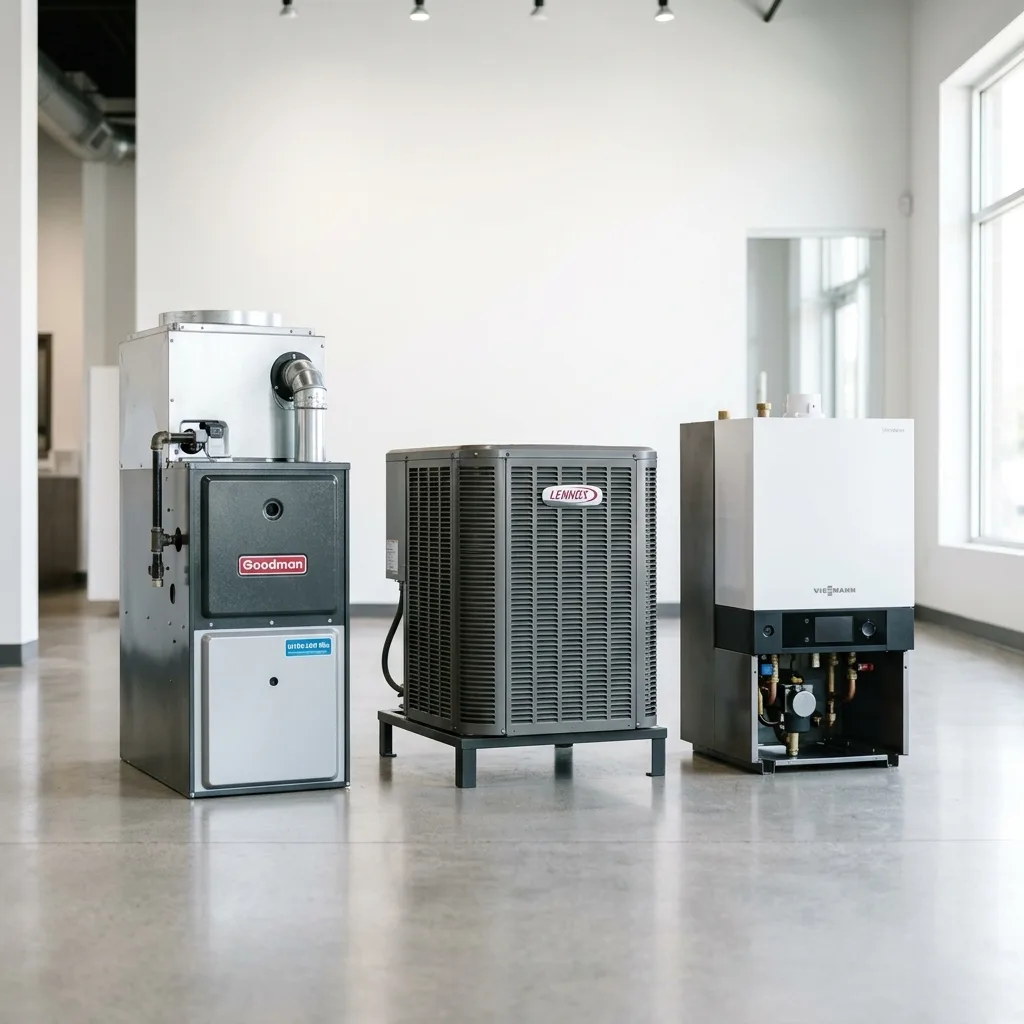
Lennox, Carrier, Trane — The highest-quality equipment with the longest warranties, quietest operation, and most advanced features (variable-speed motors, modulating gas valves, communicating controls). Premium systems command higher upfront costs but deliver the best long-term efficiency and comfort. Typical extended warranties: 10-year parts, up to limited lifetime heat exchanger. Best for homeowners who prioritize quality and plan to stay in the home long-term.
⚡ Mid-Range Tier
Bryant, Rheem, York — Excellent performance at a more moderate price point. These brands offer high-efficiency models (95%+ AFUE), two-stage and variable-speed options, and strong warranty coverage. They represent the best value for most homeowners — providing near-premium performance at 15–25% lower cost than top-tier brands. Standard warranties: 10-year parts, 20-year or limited lifetime heat exchanger.
💰 Value Tier
Goodman, Daikin — Reliable, well-built equipment at the most affordable price point. Goodman (owned by Daikin, the world's largest heating and cooling manufacturer) offers solid performance with competitive warranties. Available in 80% and 96%+ AFUE models. Best for budget-conscious homeowners, rental properties, or situations where the lowest upfront cost is the priority. Standard warranties: 10-year parts, limited lifetime heat exchanger.
Heating Installation — Your Questions Answered
Direct Answer: Complete heating installation costs range from $4,500 to $12,000 for residential gas furnaces, $10,800 to $24,600 for heat pumps, and $5,200 to $11,800 for hydronic boilers. Price includes Manual J load sizing, equipment, labor, permits, altitude derating, and equipment disposal. We provide free in-home estimates. Call +1 (719) 602-8787.
Direct Answer: Manual J is the ACCA industry-standard calculation that determines your home's precise heating load based on square footage, insulation, window ratings, and local climate. At 6,035+ ft, lower air density reduces equipment BTU output by ~20%, making accurate Manual J calculations essential to prevent short cycling or underheating.
Direct Answer: Standard gas furnace replacement takes 6 to 10 hours (1 day). Heat pump conversions or boiler installations take 1 to 2 days. Multi-zone ductless mini-splits take 2 to 3 days. We provide a detailed timeline during your initial free consultation.
Direct Answer: Dual-Fuel (Hybrid) systems—combining an electric cold-climate heat pump with a high-efficiency gas furnace—offer the ideal balance of lowest operating cost and maximum extreme cold performance in Colorado Springs.
Direct Answer: Homeowners can claim up to $2,000 in Federal Inflation Reduction Act (IRA Section 25C) tax credits for qualifying heat pumps and $600 for qualifying 97%+ AFUE furnaces, plus $250 to $1,200 in local Colorado Springs Utilities (CSU) or Xcel Energy rebates.
Direct Answer: Yes, we offer flexible financing plans including 0% APR promotional options and low-interest installment terms. Financing allows homeowners to install high-efficiency equipment immediately and offset payments with monthly energy bill savings.
Direct Answer: We install all top-tier manufacturers: Lennox, Carrier, Trane, Goodman, Rheem, Bryant, York, Daikin, and Mitsubishi (ductless). As an independent contractor, we tailor brand selection to your home's exact duct structure and budget.
Direct Answer: Air at 6,035 ft elevation has ~20% less oxygen. Factory sea-level burners overfire at altitude, producing dangerous carbon monoxide and soot. We install high-altitude burner orifices and calibrate gas manifold pressure, followed by combustion analysis testing.
Direct Answer: Single-stage furnaces run at 100% capacity whenever heating. Two-stage furnaces operate at 65% capacity on mild days and 100% on cold days. Modulating furnaces continuously adjust capacity in 1% increments from 40% to 100%, delivering whisper-quiet operation and 30% higher energy savings.
Direct Answer: Yes. Pikes Peak Regional Building Department (PPRBD) requires mechanical and electrical permits for all replacement heating equipment. We pulls all required permits and schedule county inspections to guarantee code compliance.
Get Your Free In-Home Estimate Today
A licensed technician will evaluate your home, perform a Manual J load calculation, and provide a transparent, itemized estimate — no pressure, no obligation. Multiple system options. Financing available. All installations altitude-calibrated from day one.