Boiler Repair Colorado Springs — Gas, Steam & Hot Water Hydronic Systems Serviced at 6,035 Feet
Boilers are fundamentally different from furnaces — they heat water instead of air, operate under pressure, and distribute heat through pipes to radiators, baseboard heaters, or radiant floor systems. Repairing them requires specialized knowledge of hydronic systems, water pressure management, combustion chemistry, and the unique behavior of pressurized systems at altitude. In Colorado Springs, many of the city's most distinctive neighborhoods — Old North End, Broadmoor, downtown historic homes — rely on boiler-based heating. We diagnose and repair all boiler types with altitude-calibrated combustion verification on every gas-fired service call.
How Much Does Boiler Repair Cost in Colorado Springs?
Boiler repair in Colorado Springs costs $150–$650 for most common repairs, with major component replacements reaching $500–$1,100+. A diagnostic service call runs $89–$129, credited toward the repair. Common repair costs: thermocouple replacement ($100–$400), pressure relief valve ($100–$300), zone valve replacement ($175–$500), expansion tank replacement ($200–$800), circulator pump replacement ($300–$1,100), and heat exchanger service ($500–$1,000+). Annual boiler maintenance runs $200–$500. Boiler replacement, when needed, costs $3,200–$9,000+. We provide a clear diagnosis with written estimate before any work begins. Call +1 (719) 602-8787 for service.
7 Most Common Boiler Problems in Colorado Springs
Boiler systems have unique failure patterns that differ from forced-air furnaces. Understanding the symptom helps you communicate the issue and helps us arrive prepared with the right parts.
❄️ No Heat — Boiler Not Firing
The most urgent boiler problem. The system does not ignite and no heat reaches radiators or baseboards. Common causes include a failed thermocouple or thermopile (the safety device that detects the pilot light), a malfunctioning ignition system, a tripped safety control (high-limit or low-water cutoff), a faulty thermostat, or a gas supply interruption. Before calling, check your thermostat settings, circuit breaker, and gas valve position. If the pilot light is out on an older system, you may be able to relight it following the instructions on the boiler's label — but if it will not stay lit, the thermocouple likely needs replacement.
📉 Boiler Losing Pressure
The pressure gauge reads below the normal range (typically 12–20 PSI cold, or 1.0–1.5 bar). When pressure drops too low, the boiler's low-pressure safety switch shuts the system down. Causes include a small leak in the piping, radiator valves, or boiler body — even a slow drip can cause gradual pressure loss. A failed expansion tank that cannot absorb pressure changes will cause fluctuating pressure. A stuck-open pressure relief valve will continuously release water. Recent radiator bleeding removes water from the system and reduces pressure. You can temporarily add water using the fill valve (consult your manual), but persistent pressure loss requires professional leak detection.
🌡️ Radiators Cold at Top / Uneven Heating
Radiators that are warm at the bottom but cold at the top have trapped air — the most common radiator issue. Air rises to the top of the radiator and blocks hot water from filling the unit. The fix is simple bleeding with a radiator key until water flows steadily from the bleed valve. If multiple radiators need frequent bleeding, the system has a persistent air source — possibly a failing automatic air vent, a small leak allowing air infiltration, or insufficient system pressure. If entire radiators or entire zones are cold (not just the top), the problem is more likely a failed circulator pump, a stuck zone valve, or an airlock in the piping.
🔊 Banging, Kettling & Strange Noises
"Kettling" — a rumbling or boiling-kettle sound — is caused by mineral scale buildup on the heat exchanger. Colorado Springs has moderately hard water (100–200 PPM calcium carbonate), and over years, calcium and magnesium deposits accumulate on the heat exchanger surface. Scale restricts water flow, causing localized boiling that produces steam bubbles — these collapse violently and create the banging sound. Water hammer — a sharp, single bang when the boiler or zone valve activates — is caused by sudden pressure changes in the piping, often from a loose check valve or rapid valve closure. Both issues require professional service: kettling needs a chemical powerflush, and water hammer needs valve or pipe adjustment.
💧 Water Leaking From Boiler
Water pooling around or beneath the boiler indicates a pressure relief valve discharge (the valve opened because system pressure exceeded its setting — often 30 PSI), a failed circulator pump seal, a corroded pipe fitting or boiler body, or a cracked heat exchanger. A leaking pressure relief valve may indicate a failed expansion tank — when the tank cannot absorb thermal expansion, pressure rises and the relief valve opens as a safety measure. Small, persistent leaks accelerate corrosion of nearby components and can cause water damage to flooring and walls. Any boiler leak should be professionally diagnosed — even minor leaks can indicate significant underlying problems.
🔄 Short Cycling — Boiler Turning On/Off
A boiler that fires, runs briefly, then shuts off and restarts is short cycling. This wastes energy and stresses ignition components. Causes include a faulty thermostat reading incorrect temperatures, the boiler overheating and triggering the high-limit safety switch (often from restricted water flow due to closed valves or a failing circulator pump), an oversized boiler that heats water too quickly, or at altitude, improper gas pressure causing the heat exchanger to overheat. Low water pressure can also trigger the low-water safety cutoff, causing intermittent shutdowns. Short cycling requires systematic diagnostic testing to identify the specific trigger.
📈 Rising Heating Bills
Increasing gas or electric costs without changes in usage patterns indicate declining boiler efficiency. Causes include scale buildup on the heat exchanger (reducing heat transfer — the boiler burns more fuel to produce the same heat), dirty or misaligned burners reducing combustion efficiency, a failing circulator pump that cannot distribute heat effectively (causing the boiler to run longer), pipe insulation degradation losing heat in unconditioned spaces, or at altitude, drifted gas pressure settings that have moved away from the calibrated point. A professional tune-up with combustion analysis identifies exactly where efficiency is being lost.
Boiler & Hydronic Systems We Repair
Boiler-based heating systems are a Colorado Springs specialty — found throughout the city's older neighborhoods, historic homes, custom builds, and multi-story residences where radiant heat provides superior comfort. Unlike forced-air systems that blow heated air through ductwork, hydronic systems circulate hot water (or steam) through pipes to radiators, baseboard units, or tubing embedded in floors. This produces even, draft-free warmth that many homeowners consider the most comfortable heating available.
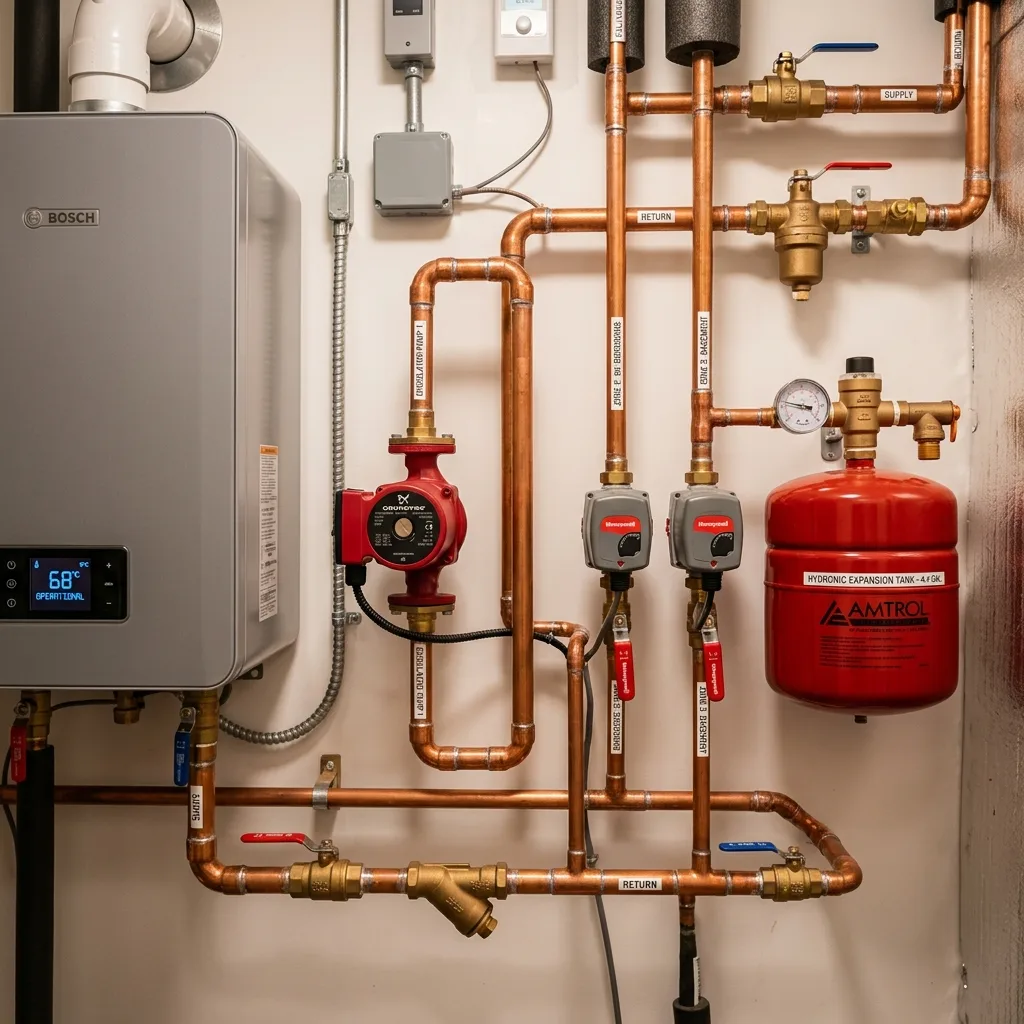
Repairing boiler systems requires knowledge that most furnace-only repair companies lack: water pressure management, air elimination, zone control logic, circulator pump hydraulics, expansion tank sizing, and the interaction between the boiler and its distribution system. We carry common boiler parts — thermocouples, zone valves, circulator pumps, pressure relief valves, and expansion tanks — for same-day repair on most service calls.
How We Approach Each Boiler & Distribution Type
Different boiler configurations and distribution systems have distinct failure patterns. Here is what we look for and how we repair each type.
🔥 Gas Hot Water Boilers
The most common boiler type in Colorado Springs. Gas boilers heat water to 140–180°F and circulate it through pipes to radiators or baseboard heaters. Common repairs include thermocouple replacement, gas valve service, circulator pump replacement, zone valve repair, expansion tank replacement, and heat exchanger cleaning. At altitude, every gas boiler repair includes combustion analysis to verify the system is burning cleanly — measuring CO PPM, O₂%, and stack temperature. Gas pressure must be calibrated to approximately 3.2" WC manifold pressure for safe combustion at 6,035 feet.
♨️ Steam Boilers
Steam systems heat water to boiling, generating steam that rises through pipes to radiators under its own pressure — no circulator pump needed. Found in older Colorado Springs homes, particularly pre-1940s construction. Steam boilers require specific expertise: maintaining proper water level (the low-water cutoff is a critical safety device), clearing sight glasses, testing pressuretrol controls, servicing steam traps (on two-pipe systems), and removing sediment from the boiler body. Steam systems are self-balancing when properly maintained but can be noisy and inefficient when components fail or air vents clog.
💎 Condensing Boilers (High-Efficiency)
Modern condensing boilers achieve 90–98% AFUE by extracting additional heat from exhaust gases that conventional boilers waste. They produce acidic condensate that must drain properly — a clogged condensate line is the most common condensing boiler failure we see. Other repairs include secondary heat exchanger cleaning, condensate trap service, outdoor temperature sensor replacement, and modulating gas valve diagnostics. These systems often use PVC venting instead of metal flue pipes, and they require lower return water temperatures (below 130°F) to achieve condensing mode — if the system runs above this temperature, it loses its efficiency advantage.
🏠 Radiators & Panel Radiators
Cast iron radiators and modern panel radiators are the visible part of a hydronic system. Radiator repairs include bleeding trapped air, replacing faulty thermostatic radiator valves (TRVs), fixing leaking supply or return valve connections, addressing cold spots from internal sludge, and replacing corroded sections. Cast iron radiators in older Colorado Springs homes can last 100+ years but their valves and connections require periodic maintenance. Modern panel radiators offer faster heat response and more precise temperature control but are more susceptible to damage from system pressure issues.
📏 Baseboard Heaters (Hydronic)
Fin-tube baseboard heaters use hot water flowing through copper tubing surrounded by aluminum fins. They provide quiet, steady heat along exterior walls. Common issues include air locks causing cold sections, bent fins reducing airflow and heat output, leaking connections at supply and return elbows, and zone valve failures that prevent water flow to specific baseboard circuits. Baseboard heaters require unobstructed airflow — ensure furniture, curtains, and carpet do not block the bottom or top openings. We also service electric baseboard heaters, which use resistance elements and require thermostat and element diagnostics.
🌊 Radiant Floor Heating
Radiant floor systems circulate warm water through tubing embedded in or beneath flooring. They provide the most uniform heat distribution of any system — heating from the floor up with no cold spots, drafts, or visible equipment. Repairs include boiler/water heater service (the heat source), circulator pump replacement, manifold valve adjustment, mixing valve service (critical for limiting floor temperature), thermostat calibration, and leak detection in embedded tubing. Radiant system leaks are complex to locate and repair because the tubing is buried — we use specialized pressure testing and thermal imaging to pinpoint leak locations without unnecessary demolition.
How 6,035 Feet Affects Boiler Operation & Repair
Gas boilers share the same altitude-related combustion challenges as gas furnaces, plus additional factors unique to pressurized water systems.
⚗️ Combustion Calibration
Gas boilers require the same altitude derating as gas furnaces — smaller orifices and adjusted manifold pressure to compensate for 20% less oxygen at 6,035 feet. Without calibration, the boiler burns rich, producing carbon monoxide, soot deposits on the heat exchanger, and accelerated corrosion. Boiler heat exchangers are particularly vulnerable because soot combined with condensation creates a corrosive acid that eats through cast iron and steel. We verify combustion on every gas boiler repair to ensure safe, clean burning at altitude.
💧 Boiling Point Changes
Water boils at a lower temperature at altitude — approximately 202°F at 6,035 feet versus 212°F at sea level. For hot water boilers, this means the margin between operating temperature and boiling is slightly narrower. Systems with scale buildup or restricted flow can reach localized boiling temperatures more easily at altitude, worsening kettling and increasing the risk of steam pocket formation. For steam boilers, the lower boiling point slightly affects system pressure behavior and pressuretrol settings. These altitude effects are subtle but real — and are factored into our diagnostic procedures.
🔧 Hard Water Impact
Colorado Springs water contains moderate mineral content (100–200 PPM calcium carbonate). In a boiler system, water is heated repeatedly as it circulates — minerals precipitate out and deposit on the heat exchanger, pipes, and circulator pump components. Over years, this scale reduces heat transfer, restricts flow, and causes the kettling sounds that boiler owners in Colorado Springs commonly report. The combination of altitude (narrower boiling margin) and hard water (accelerated scale buildup) makes Colorado Springs boilers particularly susceptible to heat exchanger issues. We recommend periodic chemical flushing (powerflushing) every 5–7 years to remove accumulated scale.
Boiler Repair Costs — Colorado Springs
Typical repair costs based on Colorado Springs market rates. Actual cost depends on boiler type, brand, and repair complexity.
* Diagnostic fee credited toward repair. All estimates provided in writing before work begins. Emergency/after-hours service may include additional fee.
Boiler Repair — Your Questions Answered
Direct Answer: Standard boiler repairs cost between $150 and $650. Diagnostic calls are $89 to $129 (credited toward repair). Pressure relief valves cost $100–$300, zone valves $175–$500, expansion tanks $200–$800, and circulator pumps $300–$1,100.
Direct Answer: A boiler losing pressure points to a leaking pipe or valve, a ruptured expansion tank internal diaphragm, a leaking heat exchanger, or a pressure relief valve discharging over-pressurized water. Cold system pressure should read 12 to 15 PSI.
Direct Answer: Radiators cold at the top indicate trapped air pockets that prevent hot water circulation. Bleeding trapped air using a radiator bleed key until a steady stream of water emerges restores full heating output.
Direct Answer: We repair high-efficiency gas condensing boilers (90%+ AFUE), cast-iron sectional boilers, electric boilers, wall-mounted combination (combi) boilers, radiant in-floor heating systems, and hydronic baseboards across brands like Navien, Weil-McLain, Lochinvar, Bosch, and Viessmann.
Direct Answer: Banging or kettling noises are caused by hard water scale buildup on heat exchanger walls. Scale restricts water flow, causing water trapped beneath scale deposits to boil instantly and create steam bubbles. Chemical flushing resolves kettling.
Direct Answer: Water boils at ~202°F at 6,035 ft elevation (compared to 212°F at sea level), narrowing safety margins for kettling. Gas burner orifices must be derated by ~24% to prevent rich combustion, soot buildup, and elevated CO output.
Direct Answer: Gas boilers require annual professional maintenance in early fall (September–October) including flue gas combustion analysis, expansion tank pre-charge check, water PH testing, and circulator pump lubrication.
Direct Answer: Repair if your boiler is under 15 years old and repair costs are reasonable. Replace if the cast-iron heat exchanger is cracked, if your unit is over 20 years old, or if Age × Repair Cost exceeds $6,000.
Direct Answer: Technicians use optical refractometers to measure propylene glycol concentrations and freeze protection ratings (target: -20°F protection), while testing fluid PH levels to prevent acid corrosion of boiler metals.
Direct Answer: Zone valve failure is caused by a burnt-out 24V synchronous motor actuator or a mechanically stuck valve body. Replacing the electrical actuator motor ($175–$350) restores hot water flow to the specific heating zone without draining system water.
Get Your Boiler Diagnosed & Repaired Today
A licensed technician with hydronic heating expertise will diagnose the problem, provide a written estimate, and complete the repair — with altitude-verified combustion on all gas-fired equipment. Same-day service available. 24/7 emergency response.