
Furnace Maintenance Colorado Springs — Altitude-Calibrated Tune-Up & Safety Inspection
Your furnace runs harder and longer at 6,035 feet than almost any other city in America. Colorado Springs' extended heating season — stretching six to seven months from October through April — combined with thin, low-oxygen air creates combustion stress that demands regular professional maintenance. Our 25-point high-altitude inspection includes digital combustion analysis, carbon monoxide testing, burner cleaning, and a complete safety verification. We catch the problems that shorten furnace life, waste energy, and create CO risk before they become emergencies.
How Much Does Furnace Maintenance Cost in Colorado Springs?
A professional furnace tune-up in Colorado Springs costs $129–$179 for a single visit. This price includes the full 25-point inspection, digital combustion analysis, carbon monoxide testing, burner cleaning, filter check, gas pressure verification, electrical inspection, and a written safety report. Annual maintenance plans may offer a lower per-visit cost with priority scheduling. At Colorado Springs' 6,035-foot elevation, annual maintenance is not optional — it is the most cost-effective way to prevent mid-winter breakdowns, maintain safe operation, protect your manufacturer warranty, and keep energy bills under control during the 6–7 month heating season. Call +1 (719) 602-8787 to schedule your tune-up.
Why Furnace Maintenance at 6,035 Feet Is Different From Anywhere Else
Colorado Springs is not a typical heating market. The combination of high altitude, extreme temperature swings, dry air, and extended heating demands creates unique maintenance requirements that standard sea-level service protocols do not address.
🌬️ 20% Less Oxygen
At 6,035 feet, each cubic foot of air contains roughly 20% less oxygen than at sea level. Gas furnaces rely on oxygen for combustion — less oxygen means the fuel-to-air ratio shifts. Without altitude-specific maintenance, burners produce incomplete combustion: more soot deposits on heat exchangers, more carbon monoxide in flue gases, and more wasted energy. Every maintenance visit must include a combustion analysis to verify the burn is clean and efficient at this elevation.
🌡️ Extreme Temperature Swings
Colorado Springs routinely experiences 40–50°F daily temperature swings — mornings in the teens, afternoons near 50°F. This forces your furnace to cycle on and off far more frequently than furnaces in stable climates. Frequent cycling accelerates wear on ignition systems, flame sensors, blower motors, and gas valves. Components that might last 10 years in moderate climates may need attention in 6–8 years here. Regular inspection catches wear before it becomes failure.
❄️ Extended Heating Season
While many U.S. cities use their furnace 4–5 months per year, Colorado Springs homeowners rely on heating from October through April — and occasionally into May after late-season snowstorms. That is 6–7 months of continuous demand. Heating accounts for approximately 48% of the average residential energy bill here. A furnace running at degraded efficiency for that many months costs hundreds of dollars more per season than a properly maintained unit.
What Professional Furnace Maintenance Actually Prevents
Most homeowners think of furnace maintenance as "changing the filter." A professional tune-up goes far deeper — and the stakes at altitude are higher than you might expect. The most dangerous furnace failure — a cracked heat exchanger — produces no visible symptom until carbon monoxide enters your living space. A properly trained technician with combustion analysis equipment can detect the early stages of heat exchanger degradation, incomplete combustion, and gas pressure drift months or years before these conditions create a safety emergency.
Beyond safety, maintenance directly protects your investment. The average furnace replacement in Colorado Springs costs $3,500–$7,500. Regular maintenance extends furnace lifespan from a typical 15 years to 20–25 years for well-maintained units. That is potentially an extra decade of service from equipment you have already paid for. The math is straightforward: a $129–$179 annual tune-up that prevents even one $400 repair and extends equipment life by several years delivers a return many times its cost.
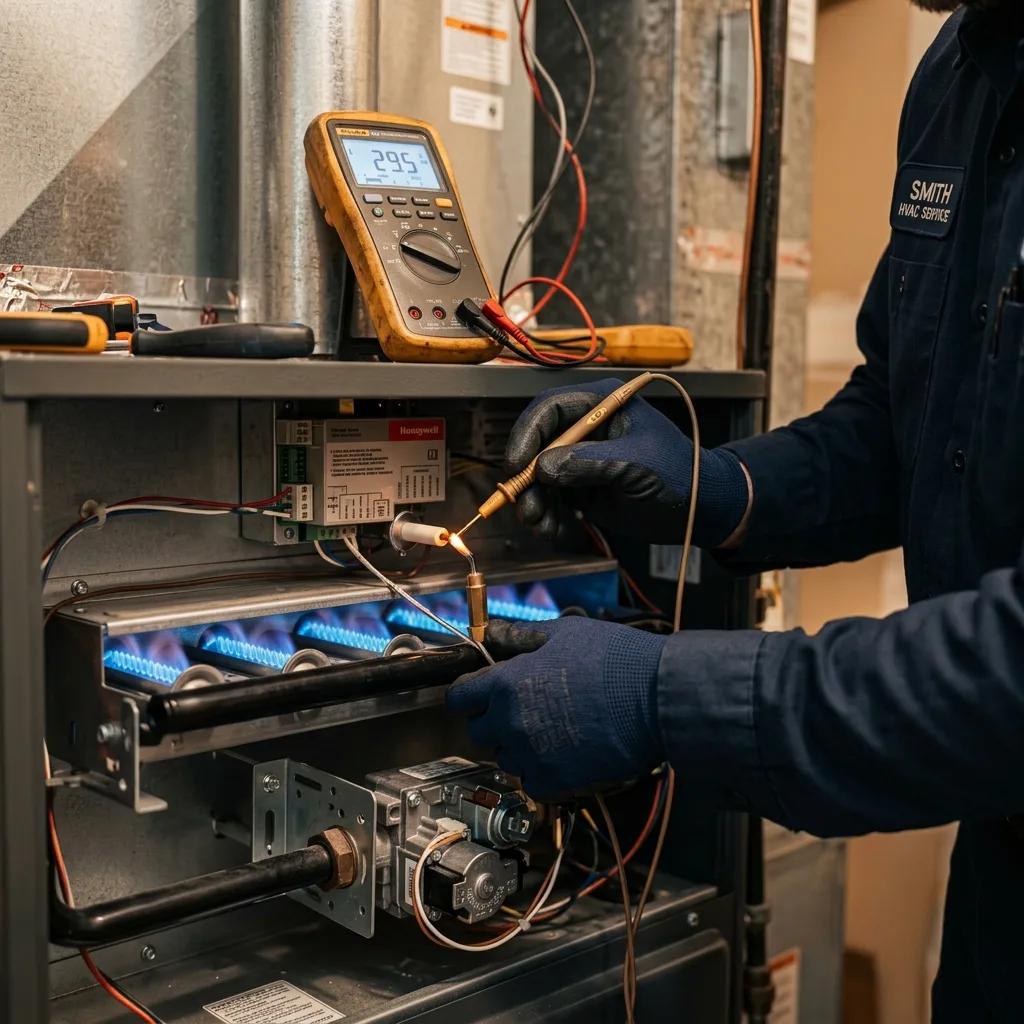
What Our Furnace Tune-Up Includes — Complete Checklist
Every maintenance visit follows our altitude-calibrated protocol. Each of these 25 inspection points is checked, documented, and included in your written safety report.
* All 25 inspection points are completed during every maintenance visit. If a repair is needed, we provide a separate written estimate before performing any additional work. No surprise charges.
When to Schedule Furnace Maintenance in Colorado Springs
Timing matters. Colorado Springs' unique climate dictates a maintenance schedule that differs from national recommendations. Here is the altitude-adjusted calendar we use for our customers.
Pre-Season Tune-Up — The Most Important Visit
This is the primary maintenance window. Schedule your annual or bi-annual tune-up before the first sustained cold arrives — usually in mid-to-late October. During this visit, we perform the full 25-point inspection, clean and adjust burners, verify combustion at altitude, test all safety controls, and replace or clean the air filter. Catching problems now means fixing them on your schedule, not during a January emergency. Most general heating and cooling companies have shorter scheduling windows in September, so booking early gives you more flexibility.
Early Season Monitoring Period
After your fall tune-up, monitor your furnace during the first weeks of heavy use. Listen for unusual sounds — banging at startup (delayed ignition), screeching (bearing wear), or clicking (igniter struggling). Watch for uneven heating between rooms or noticeable temperature differences between floors. Check your filter monthly during this period. Colorado's dry winter air carries fine dust that loads filters faster than summer months. If you notice any changes in performance, call before the problem escalates.
Mid-Winter Safety Check (Recommended)
For homes at altitude, we recommend a mid-winter safety check during the peak heating months. January and February bring the coldest sustained temperatures — average lows drop to 14–19°F with periodic dips well below zero. Your furnace is running at maximum demand during these months. A mid-winter check verifies that combustion remains clean after months of continuous operation, gas pressure has not drifted, and the heat exchanger is handling thermal stress without developing cracks. This second visit is particularly valuable for furnaces over 10 years old.
Late Season Assessment & Transition
Colorado Springs heating season does not end in March. Late-season snowstorms are common through April, and nighttime temperatures regularly drop into the 20s and 30s. Continue checking your filter monthly. As the heating season winds down in late April, note any issues that appeared during winter — inconsistent heating, strange smells at startup, increased cycling frequency. Document these for your next fall tune-up so your technician can focus on the areas that showed symptoms during heavy use.
Off-Season Planning & Preparation
Summer is the best time to address any repairs or upgrades identified during winter. heating contractors have more availability, parts are in stock, and you are not waiting for heat while work is completed. If your furnace is approaching 15 years old or required multiple repairs last winter, summer is the ideal time to schedule a replacement estimate. Use this window to also clean your ductwork, upgrade your thermostat, or address insulation issues that affected comfort last winter.
6 Reasons Furnace Maintenance Pays for Itself in Colorado Springs
Furnace maintenance is not an expense — it is the least expensive way to avoid the most expensive furnace problems. Here is how regular service protects your home, your budget, and your family.
🛡️ Carbon Monoxide Prevention
Carbon monoxide is colorless and odorless — you cannot detect it without equipment. The CDC reports over 400 CO-related deaths annually in the United States, with residential furnaces among the leading sources. At altitude, the risk is elevated: reduced oxygen increases the likelihood of incomplete combustion, which produces CO. Our combustion analysis measures CO levels in parts per million directly from the flue, catching dangerous conditions before they threaten your family.
💰 Lower Energy Bills
A well-maintained furnace operates at or near its rated AFUE efficiency. Dirty burners, clogged filters, and miscalibrated gas pressure degrade performance gradually — often without obvious symptoms until you notice your energy bill climbing. In Colorado Springs, where heating represents 48% of average residential energy costs over a 6–7 month season, even a 10% efficiency loss translates to $150–$300 in wasted energy per winter. Regular maintenance keeps your system running at peak efficiency.
🔧 Fewer Emergency Repairs
Most furnace breakdowns are not sudden catastrophic failures — they are the end result of gradual component degradation that was never caught. A dirty flame sensor causes ignition failure. A worn capacitor causes a blower to stall. A loose wire causes intermittent shutdown. All of these are discovered and corrected during routine maintenance at a fraction of the cost of an emergency repair call. Emergency heating repairs in Colorado Springs typically cost $200–$600+ versus $129–$179 for scheduled maintenance.
📅 Extended Equipment Lifespan
A gas furnace has a designed lifespan of 15–20 years. At Colorado Springs' altitude, furnaces that are never maintained may fail in 10–12 years due to accelerated combustion wear, dirty components, and unaddressed thermal stress. Properly maintained furnaces routinely reach 20–25 years of service. The cost of annual maintenance over 20 years ($2,500–$3,500) is a fraction of the $5,000–$7,500 cost of premature furnace replacement.
📋 Warranty Protection
Nearly every furnace manufacturer — Lennox, Carrier, Trane, Goodman, Bryant, Rheem, York — requires annual professional maintenance to maintain warranty coverage. If your heat exchanger cracks at year 8 of a 10-year warranty and you cannot document annual maintenance, the manufacturer may deny the warranty claim. A warranty-covered heat exchanger replacement is $0. An out-of-warranty replacement is $1,500–$3,500 — or may require full furnace replacement. Keep your maintenance records.
🏠 Consistent Home Comfort
Comfort is not just about temperature — it is about consistency. A properly maintained furnace delivers even heating throughout your home, operates quietly, cycles at predictable intervals, and maintains stable humidity levels. When components degrade, you notice: rooms that are too cold while others are too warm, temperature swings between cycles, cold spots near exterior walls, and a furnace that runs almost continuously without reaching the thermostat set point. Maintenance restores consistent, reliable comfort.
Maintenance Cost vs. Repair & Replacement Cost
The numbers speak clearly: preventive maintenance is the least expensive option in every scenario. Here is how the costs compare over a typical furnace lifespan in Colorado Springs.
* Costs are estimates based on Colorado Springs market rates. Actual costs depend on furnace brand, model, age, and specific repair needs. Annual maintenance reduces the likelihood and frequency of all other cost categories.
Furnace Maintenance Plans — Colorado Springs
A maintenance plan simplifies scheduling, reduces per-visit costs, and provides priority service when you need it most. Here is what our plans include.
🔧 What's Included
Each plan includes one or two scheduled maintenance visits per year (depending on plan level) with the full 25-point altitude-calibrated inspection. You receive priority scheduling — plan members are scheduled ahead of non-members during the busy fall and winter seasons. Filter replacements during scheduled visits are included. You also receive a written condition report after each visit documenting findings, recommendations, and the overall health of your system.
⚡ Priority Emergency Service
When plan members call with a no-heat emergency during winter, they are moved to the front of the service queue. In January and February — when Colorado Springs heating companies are at peak demand — non-members may wait 24–48 hours for service. Plan members receive same-day or next-morning priority. In sub-zero conditions, a few hours can make the difference between a cold inconvenience and frozen pipes.
💵 Repair Discounts
If your maintenance visit reveals a component that needs repair, plan members receive a discount on parts and labor for any necessary work. This further reduces the cost of ownership and provides an additional financial incentive to catch problems early — when they are smaller and less expensive to fix — rather than waiting for a complete failure that requires emergency service rates and expedited parts ordering.
Homeowner Maintenance Tasks You Can Do Yourself
Professional maintenance handles the internal safety and performance checks that require tools and training. Between visits, these homeowner tasks keep your furnace running smoothly and reduce the risk of problems developing between scheduled service.
🔄 Replace Filters Monthly
Colorado Springs' dry, dusty air loads filters faster than humid climates. Check your filter every 30 days during the heating season and replace it when it appears gray or clogged. A dirty filter restricts airflow, forces longer furnace cycles, increases energy consumption, and can cause the system to overheat and trigger the safety limit switch. Standard 1" filters typically need replacement every 1–2 months during winter; 4" media filters last 3–6 months.
🧹 Keep the Area Clear
Maintain at least 3 feet of clearance around your furnace on all sides. Remove boxes, stored items, paint cans, cleaning supplies, and any combustible materials. The furnace needs unobstructed air intake for safe combustion — especially at altitude where available oxygen is already reduced. A cluttered furnace room also makes it difficult for technicians to access the unit during maintenance or emergency service calls.
👂 Listen and Watch
Pay attention to changes in your furnace's behavior. New sounds — banging at startup, metallic rattling, high-pitched squealing, or repeated clicking — indicate developing problems. Watch for a yellow or orange burner flame (healthy flame is blue with small yellow tips), unusual smells (especially metallic or burning odors), and visible soot around the furnace. Any of these symptoms warrant a professional inspection before the next scheduled maintenance visit.
Furnace Maintenance — Your Questions Answered
Direct Answer: A professional furnace tune-up in Colorado Springs costs $129 to $179 for a single visit. This includes our comprehensive 25-point altitude inspection, digital combustion analysis, carbon monoxide safety check, flame sensor cleaning, and a written report. Call +1 (719) 602-8787 for current rates.
Direct Answer: Servicing your furnace once per year in early fall is essential. Because Colorado Springs heating seasons span 6 to 7 months with heavy burner runtimes, older furnaces (>10 years) benefit from bi-annual checks in fall and mid-winter.
Direct Answer: Our 25-point tune-up includes digital combustion analysis (CO PPM, O₂%), gas manifold pressure check, flame sensor microamp testing, hot surface igniter resistance check, heat exchanger borescope inspection, blower motor amp draw test, safety limit switch testing, and filter replacement.
Direct Answer: At 6,035 feet, oxygen levels are ~20% lower. Furnaces burn fuel in oxygen-lean air, which accelerates soot accumulation, elevates CO risks, and degrades efficiency faster than at sea level. Maintenance verifies correct high-altitude fuel derating.
Direct Answer: September through mid-October is the ideal window. Scheduling before cold weather hits ensures any developing component wear is repaired prior to heavy winter heating demand.
Direct Answer: Yes. Routine maintenance detects thermal stress cracks in heat exchangers before CO leaks into supply air and verifies proper flue draft to prevent backdrafting toxic gases.
Direct Answer: Yes. Clean burners, calibrated gas pressure, and clean air filters reduce furnace fuel consumption by 5% to 15% per season, saving $150 to $300 annually on Colorado Springs heating bills.
Direct Answer: Neglecting maintenance leads to higher utility bills, sudden mid-winter breakdowns, premature heat exchanger cracking, loss of 5 to 8 years of equipment lifespan, and voided manufacturer warranty coverage.
Direct Answer: Yes. Top manufacturers (Lennox, Carrier, Trane, Goodman, Rheem) explicitly require annual professional maintenance records. Without documented tune-ups, warranty claims for major components like heat exchangers ($1,500+) may be denied.
Direct Answer: Technicians clean oxidized carbon buildup from the sensor rod using ultra-fine 0000 steel wool or emery cloth, then measure DC microamp current with a multimeter to ensure it reads between 1.5 and 5.0 μA.
Protect Your Furnace Before Winter Arrives
A licensed technician will perform the full 25-point altitude-calibrated inspection, combustion analysis, and safety verification. You will receive a written report documenting every finding. No surprise charges. No pressure.