
Heat Pump Repair Colorado Springs — Air Source, Mini-Split & Cold-Climate Diagnostics at 6,035 Feet
Heat pumps are precision systems — they move heat through a refrigerant cycle that is sensitive to temperature, pressure, and air density. At Colorado Springs' 6,035-foot elevation, all three variables differ from sea level. Standard diagnostic procedures produce misleading readings. Refrigerant pressure charts must be altitude-adjusted. Defrost timing behaves differently in thinner air. We diagnose and repair air source heat pumps, ductless mini-splits, cold-climate models, and dual-fuel systems with altitude-calibrated precision. EPA Section 608 certified for all refrigerant types.
How Much Does Heat Pump Repair Cost in Colorado Springs?
Heat pump repair in Colorado Springs costs $150–$650 for most common repairs, with major component repairs reaching $800–$3,500+. A diagnostic service call runs $89–$129, credited toward the repair. Common repairs and costs: capacitor replacement ($150–$300), contactor replacement ($150–$350), fan motor replacement ($200–$700), defrost control board ($200–$650), reversing valve ($350–$700), refrigerant leak repair and recharge ($100–$750), and compressor replacement ($800–$3,500+). EPA-certified refrigerant handling is required for all heat pump work. We provide a clear diagnosis with written estimate before any repair begins. Call +1 (719) 602-8787 for service.
7 Most Common Heat Pump Problems in Colorado Springs
Heat pumps are more complex than furnaces — they have both indoor and outdoor components, a refrigerant cycle, and a defrost system. Here are the problems we see most at altitude and what causes them.
❄️ Heat Pump Blowing Cold Air
The most reported heat pump complaint in winter. Common causes: thermostat set to "Cool" or fan set to "On" instead of "Auto," a stuck reversing valve that cannot switch from cooling to heating mode, low refrigerant charge reducing heat absorption capacity, or the system temporarily running in defrost mode (normal — lasts 5–15 minutes). At altitude, reduced air density also slightly reduces heat transfer efficiency at the outdoor coil, which can make output feel cooler than expected even when the system is working correctly. Check thermostat settings first. If cold air persists beyond 15 minutes, call for diagnosis.
🧊 Excessive Ice on Outdoor Unit
A light frost coating on the outdoor coil is normal during cold, damp weather — the defrost cycle should clear it periodically. Thick ice that covers the entire unit or never clears indicates: a faulty defrost control board (the circuit that triggers defrost cycles), a failed defrost sensor or thermostat (cannot detect when defrost is needed), low refrigerant charge (coil temperature drops too low), a stuck reversing valve (cannot switch to "cooling" mode for defrost), or a failed outdoor fan motor (no airflow to assist heat exchange). Never chip or scrape ice off — this damages the delicate aluminum coil fins.
🔄 System Not Switching Modes
If your heat pump heats but does not cool (or vice versa), the reversing valve is the primary suspect. This electromagnetic valve directs refrigerant flow either for heating or cooling. When it fails — due to mechanical wear, solenoid failure, or refrigerant contamination — the system becomes locked in one mode. Symptoms include the system blowing warm air in cooling mode, cold air in heating mode, or making an audible clicking/hissing sound when attempting to switch. Reversing valve diagnosis requires pressure and temperature measurements at multiple system points.
🔊 Unusual Noises
Heat pumps produce some normal sounds: a "swooshing" during defrost mode changes, gentle clicking when the reversing valve activates, and steady fan hum during operation. Abnormal sounds that require attention: grinding (compressor bearing failure — urgent), loud rattling (loose components, debris in the outdoor unit, or a failing fan motor), high-pitched squealing (belt or motor bearing wear), buzzing at the outdoor unit (contactor or electrical issue), or persistent clicking without startup (failed capacitor or control board). Grinding from the compressor is the most urgent — continued operation risks catastrophic compressor damage.
📉 Poor Heating Performance
The system runs but cannot maintain the thermostat set point — rooms feel cool despite continuous operation. This is particularly common in Colorado Springs during extreme cold. Causes include: low refrigerant charge (the system cannot absorb enough heat from the outdoor air), dirty outdoor coil restricting heat exchange, auxiliary heat not activating when needed, a failing compressor losing pumping capacity, or an undersized system that lacks sufficient capacity for your home's heating load at altitude. Before calling, check that your air filter is clean and the outdoor unit is clear of snow and debris.
🔌 System Not Turning On
A heat pump that will not start at all is typically caused by: a tripped circuit breaker (check your electrical panel — heat pumps may have two breakers, one for indoor and one for outdoor), a failed capacitor (stores the electrical charge needed to start the compressor and fan motors), a tripped high-pressure or low-pressure safety switch, a disconnected or failed thermostat, or the outdoor disconnect switch being turned off. Check breakers and thermostat batteries first. If power is confirmed and the system still will not start, professional diagnosis of the electrical and control circuits is needed.
💧 Water Leaking Indoors
Water pooling around the indoor unit (air handler) during heating operation usually indicates: a clogged condensate drain line (the most common cause), a cracked or overflowing drain pan, a frozen indoor coil that is thawing and producing excess water, or a refrigerant issue causing abnormal coil temperatures. During heating mode, the indoor coil acts as the condenser and produces less condensation than during cooling — so water leaks during heating often point to a more significant underlying issue like low refrigerant or airflow restriction.
Every Heat Pump System — Diagnosed & Repaired
Colorado Springs has seen rapid growth in heat pump adoption over the past decade — driven by improving cold-climate technology, rising natural gas costs, and increasing energy efficiency awareness. We repair the full range of heat pump systems found in homes throughout the Pikes Peak region, from standard ducted air-source units to sophisticated multi-zone ductless mini-splits and modern cold-climate models designed for sub-zero operation.
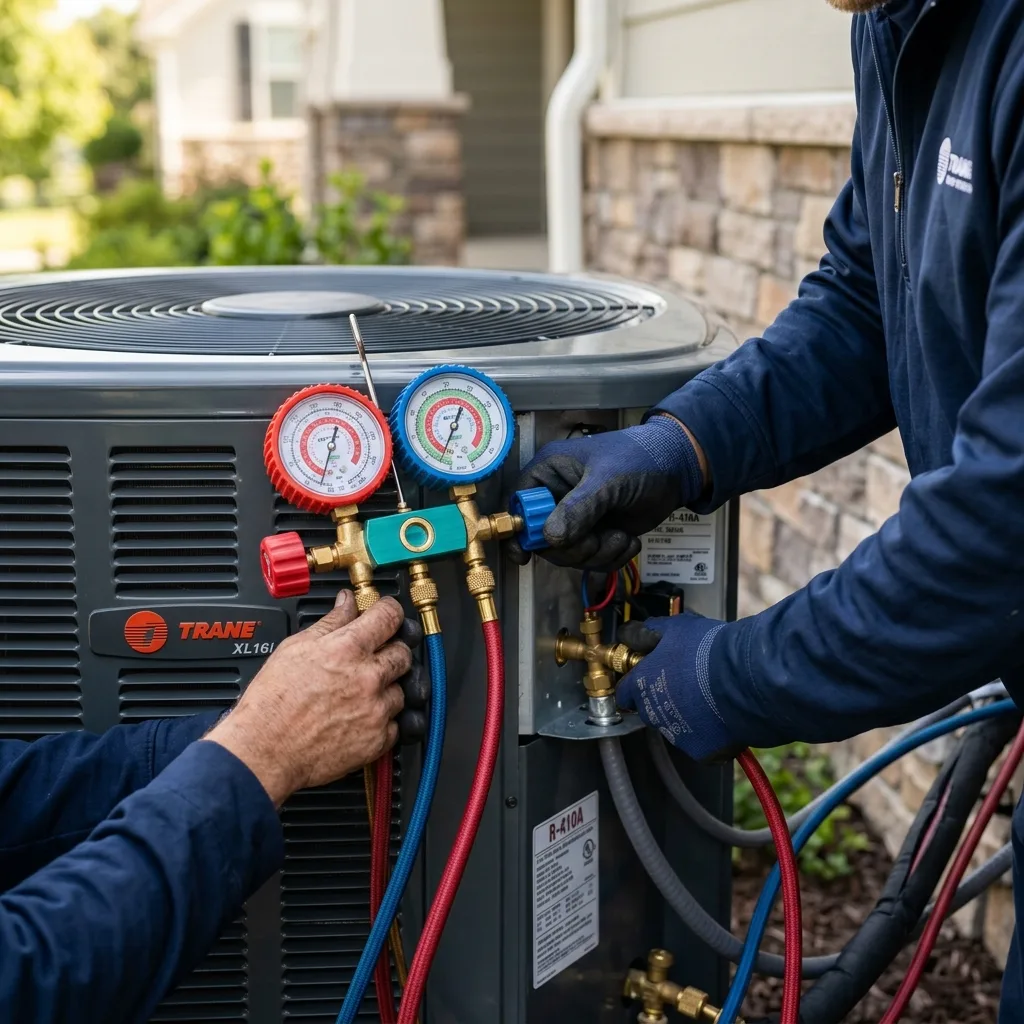
Heat pump repair requires specialized knowledge that goes beyond general heating system training. These systems involve refrigerant cycle management, pressure-temperature relationships that change with altitude, EPA-regulated refrigerant handling, and electrical diagnostics across both indoor and outdoor components. Our technicians hold EPA Section 608 Universal certification for all refrigerant types and carry diagnostic equipment specifically designed for heat pump systems — including digital manifold gauges, superheat and subcooling calculators, and airflow measurement tools.
How We Approach Each Heat Pump Type
Different heat pump configurations have distinct failure patterns and diagnostic requirements. Here is how we handle each system type found in Colorado Springs.
🏠 Ducted Air-Source Heat Pumps
The most common heat pump type — a single outdoor condenser connected to an indoor air handler with ductwork. These systems heat and cool your entire home through existing duct infrastructure. Common repairs include compressor service, reversing valve replacement, refrigerant management, fan motor replacement, defrost system service, and thermostat/control board diagnostics. At altitude, refrigerant charge must be verified using altitude-adjusted pressure-temperature charts — sea-level charts produce incorrect superheat and subcooling readings that lead to misdiagnosis.
📱 Ductless Mini-Split Systems
Mini-splits use one outdoor unit connected to one or more wall-mounted indoor units — each independently controlled. Common in additions, converted spaces, and homes without ductwork. Repairs include indoor unit fan motor service, drain line clearing, outdoor unit compressor and fan service, refrigerant line repair, communication board diagnostics (the indoor and outdoor units "talk" to each other electronically), and error code interpretation. Mini-splits display alphanumeric error codes that identify the specific malfunction — we can often narrow the diagnosis before arriving based on the code you report.
❄️ Cold-Climate Heat Pumps
Modern cold-climate models (Mitsubishi Hyper-Heat, Daikin Fit, Carrier Infinity with Greenspeed, etc.) are engineered for sub-zero heating performance using variable-speed inverter compressors that adjust output continuously rather than cycling on/off. These systems require specialized diagnostic tools — standard manifold gauges may not provide accurate readings on inverter-driven compressors. Repairs include inverter board diagnostics, variable-speed compressor service, enhanced defrost system troubleshooting, and outdoor coil cleaning in Colorado's dusty environment.
🔄 Dual-Fuel Systems
Dual-fuel pairs a heat pump with a gas furnace — the heat pump provides efficient heating in moderate weather while the furnace handles extreme cold. Repair requires expertise in both heat pump and gas furnace systems. Common issues include switchover logic failures (the system does not transition between heat pump and furnace at the correct temperature), thermostat compatibility problems, control board communication errors, and improper switchover temperature settings. We verify that the switchover point is optimized for Colorado Springs energy costs and climate conditions.
How 6,035 Feet Changes Heat Pump Diagnostics
Heat pump diagnostics at altitude is fundamentally different from sea-level service. The reduced air density affects every measurement a technician takes. Here is what changes and why it matters.
📊 Pressure Readings Change
Refrigerant pressure is directly affected by the temperature and density of the air passing over the outdoor coil. At 6,035 feet, lower air density means lower heat transfer at the outdoor coil, which produces different suction and discharge pressures than a sea-level installation would show. A technician using standard pressure-temperature charts may conclude the system is undercharged when it is actually correctly charged for altitude — then add refrigerant, overcharging the system and risking compressor damage. We use altitude-adjusted diagnostic procedures and manufacturer-specific charts for accurate readings.
🌡️ Capacity Reduction
A heat pump's rated heating capacity (measured in BTU) drops at altitude because thinner air carries less thermal energy per cubic foot. A system rated at 36,000 BTU at sea level may deliver only 28,000–30,000 BTU at 6,035 feet. This capacity reduction is separate from the normal capacity drop that occurs as outdoor temperatures decrease. Both factors compound in Colorado Springs — the coldest days combine low temperatures with thin air, creating the greatest capacity deficit when you need heating most. Proper system sizing must account for both altitude and design temperature.
⚠️ Defrost Behavior Differs
The defrost cycle on a heat pump is triggered by a combination of coil temperature, time, and pressure readings — all of which behave differently at altitude. Lower air density affects frost formation patterns on the outdoor coil, and standard defrost timing may not match the actual conditions at 6,035 feet. A defrost board calibrated for sea-level operation may initiate defrost too frequently (wasting energy) or too infrequently (allowing ice buildup that blocks airflow). We verify defrost timing against actual coil conditions rather than relying solely on factory settings.
Heat Pump Repair Costs — Colorado Springs
These are typical repair costs based on Colorado Springs market rates. Your actual cost depends on system type, brand, refrigerant type, and repair complexity.
* Diagnostic fee credited toward repair. R-22 refrigerant systems may incur higher costs due to phase-out pricing. All estimates provided in writing before work begins.
Heat Pump Repair — Your Questions Answered
Direct Answer: Standard heat pump repairs cost between $150 and $650. Diagnostic service calls are $89 to $129 (credited toward repair). Capacitor and contactor replacements run $150–$350, fan motors $200–$700, reversing valves $350–$700, and compressor replacements $800–$3,500+.
Direct Answer: A heat pump blowing cold air in heat mode is caused by a continuous thermostat fan setting ("On"), a stuck reversing valve failing to shift refrigerant flow, a low refrigerant leak, or the unit actively running a 5–15 minute defrost cycle.
Direct Answer: Thin frost is normal and melts during automatic defrost cycles every 30 to 90 minutes. Heavy, solid ice encasing the outdoor unit indicates a broken defrost control board, failed defrost temperature sensor, stuck reversing valve, or low refrigerant level requiring technician repair.
Direct Answer: We service all ducted air-source heat pumps, ductless mini-splits (single and multi-zone), cold-climate inverter models, and dual-fuel hybrid systems across major brands like Mitsubishi, Daikin, Carrier, Lennox, Trane, Fujitsu, LG, Goodman, and York.
Direct Answer: Lower atmospheric pressure at 6,035 ft reduces ambient air density and alters gauge pressure (PSIG) readings. Technicians must use elevation-adjusted PT chart conversions when charging refrigerant to prevent overcharging or undercharging.
Direct Answer: Heat pumps require bi-annual maintenance—once in spring before cooling season and once in early fall before heating season—because they operate year-round for both heating and cooling.
Direct Answer: Repair if your system is under 12 years old and repair costs are reasonable. Replace if your unit is over 15 years old, uses phased-out R-22 refrigerant, has a dead compressor, or if Age × Repair Cost exceeds $5,000.
Direct Answer: "Heat" runs the heat pump primary compressor with backup heat as needed. "Emergency Heat" locks out the heat pump entirely and runs only high-cost auxiliary electric heat strips. Only switch to Emergency Heat if your outdoor heat pump fails.
Direct Answer: Technicians detect leaks using electronic halogen leak detectors, ultraviolet dye injection, and nitrogen pressure testing up to 350 PSI to locate micro-fissures in copper coils or flare fittings before recharging R-410A or R-32 refrigerant.
Direct Answer: Auxiliary electric heat strips run continuously if the outdoor heat pump compressor trips its capacitor, loses refrigerant, or if outdoor temperatures drop below the balance point without a dual-fuel gas backup. Continuous aux heat spikes electric bills by 50%+.
Get Your Heat Pump Diagnosed & Repaired Today
An EPA-certified technician will diagnose the problem using altitude-adjusted procedures, provide a clear written estimate, and complete the repair. Same-day service available. 24/7 emergency response for no-heat situations.