
📅 Sep 15, 2025 · 12 min read
Furnace Repair vs. Replace Guide
The data-driven financial framework for deciding whether to repair your existing furnace or invest in a new high-efficiency system.
Furnace Repair vs. Replacement →Direct Answer: A furnace replacement quote in Colorado Springs is built from five parts: equipment tier, installation labour, venting and gas work, the PPRBD mechanical permit and inspection, and any ductwork correction. Equipment is usually the smallest share of the difference between two bids. The gap is nearly always in the last three items, which is where cheap quotes cut.
Equipment tier sets the floor. An 80% AFUE single-stage furnace is the entry point; a 96% two-stage unit sits in the middle; a 98% modulating furnace with a variable-speed ECM blower is the top. The spread between tiers is real but narrower than most homeowners expect, and in a climate with more than 5,500 heating degree days the higher tiers recover part of that difference through the long heating season.
Labour varies with access more than with brand. A furnace in an open basement with clear working room is a straightforward swap. The same unit in a tight attic, a crawlspace with limited headroom, or a closet that requires removing a door frame adds hours. Mountain properties in Cascade, Woodland Park and Black Forest also carry travel time and, in winter, access uncertainty that an honest quote accounts for.
Four line items explain most of the variance between competing bids: whether the venting configuration changes, whether existing ductwork can carry the required airflow, whether the permit and inspection are included, and whether the altitude orifice kit and commissioning measurements are part of the scope. A bid that omits any of these is not cheaper — it has moved the cost to a change order or left the work undone.
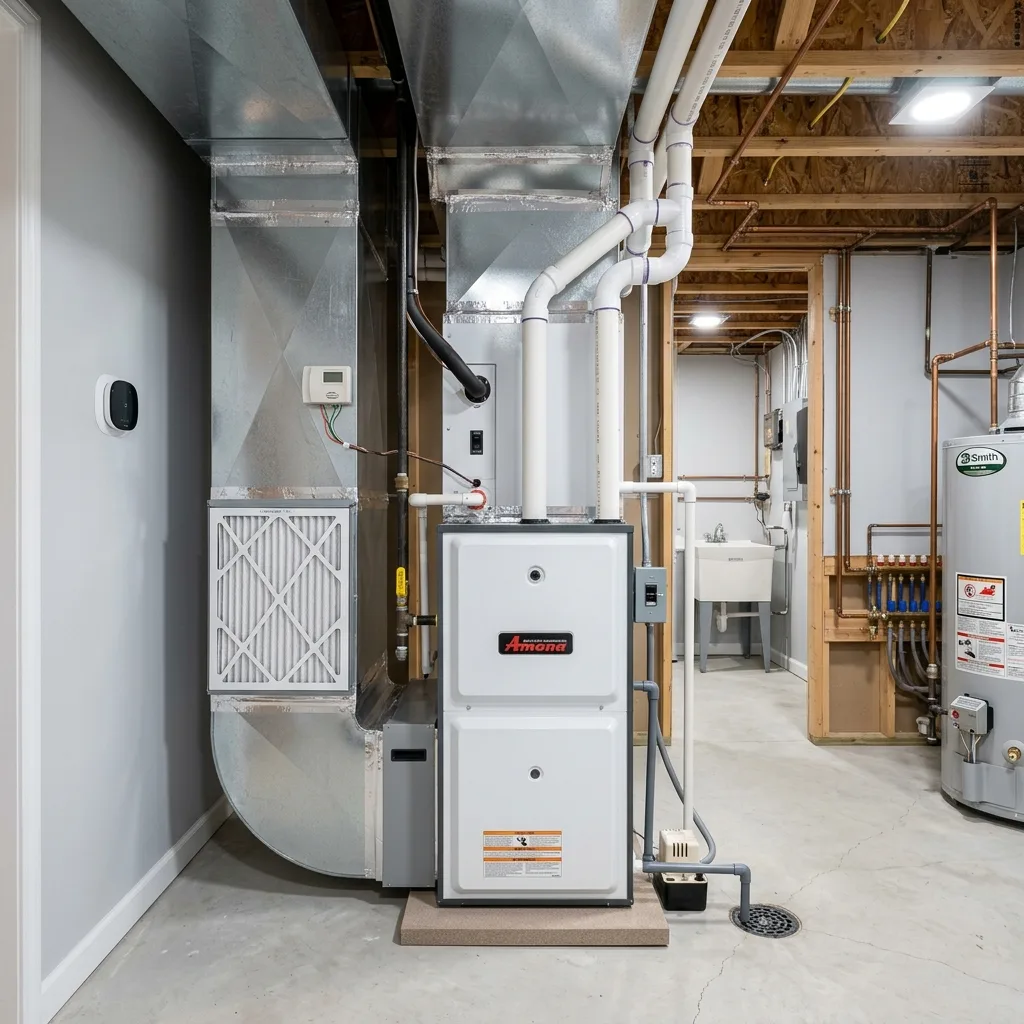
Venting is the most common source of a surprise. Moving from an 80% furnace on a masonry chimney to a 96% condensing unit means new PVC intake and exhaust routed to a sidewall, plus a condensate drain with freeze protection if any of it runs through unconditioned space. It can also orphan a water heater that shared the old chimney, leaving it unable to draft properly — a code issue that must be resolved as part of the same project, not later.
Ductwork is the second. A modern variable-speed blower moves more air than the PSC blower it replaces, and many Colorado Springs homes built before 1990 have return-air paths sized for the older equipment. If external static pressure measures above roughly 0.5 inches of water column, the new furnace will trip its high-limit switch regardless of quality. Correcting a return path is real cost, and a bid that does not mention a static pressure measurement has not looked.
The permit is non-negotiable and inexpensive relative to the job. A PPRBD mechanical permit and inspection verify venting, combustion air, gas piping, condensate handling and the altitude-appropriate orifice and manifold settings. Beyond code compliance, most Colorado Springs Utilities rebates require proof of a permitted, inspected installation, so skipping it to save a few hundred dollars can forfeit a larger rebate and complicate a future home sale.
Ask every bidder for four specific things in writing: the equipment model number and its AFUE, confirmation that a high-altitude orifice kit is included and the gas valve will be adjusted, the PPRBD permit number or a statement that permit and inspection fees are included, and the commissioning measurements that will be recorded at handover — manifold pressure, temperature rise and external static pressure.
Those four items make bids genuinely comparable. Two quotes that differ by a significant margin usually differ because one includes duct correction, permit fees and commissioning while the other assumes the existing ductwork is adequate and the permit is optional. Requesting the same scope from each contractor turns a confusing spread of numbers into a straightforward comparison, and it exposes the bid that was cheap because it planned to do less.
| Cost Component | What Changes It | Typical Impact on Quote | Question to Ask the Contractor |
|---|---|---|---|
| Equipment tier | 80% vs 96% vs modulating | Moderate | What is the model number and AFUE? |
| Installation labour | Access, attic or crawlspace | Moderate to high | How many hours and how many technicians? |
| Venting change | Chimney to PVC sidewall | High | Does this orphan the water heater? |
| Ductwork correction | Static pressure over 0.5" w.c. | High | Did you measure static pressure? |
| Permit and inspection | PPRBD mechanical permit | Low cost, high consequence | Are permit fees included in this price? |
Ask every bidder for the model number, the altitude orifice kit, the permit and the commissioning numbers. Then the quotes are comparable. Call 719-602-8787 for a written scope.
Direct Answer: Usually scope, not equipment. The gap between bids is typically in venting changes, ductwork correction, permit and inspection fees, and whether the altitude orifice kit and commissioning measurements are included. Equipment tier is generally the smallest part of the difference. A cheaper bid has often moved those costs to a change order or planned to skip them.
Direct Answer: Yes. A Pikes Peak Regional Building Department mechanical permit is required, and the inspection verifies venting, combustion air, gas piping, condensate handling and the altitude-appropriate orifice and manifold settings. Most Colorado Springs Utilities rebates also require proof of a permitted, inspected installation, so skipping it can forfeit a larger rebate.
Direct Answer: A modern variable-speed blower moves more air than the PSC blower it replaces, and many Colorado Springs homes built before 1990 have returns sized for the older equipment. If external static pressure measures above about 0.5 inches of water column, the new furnace will trip its high-limit switch regardless of equipment quality. A bid that never mentions measuring static pressure has not checked.
Direct Answer: When an 80% furnace and a water heater share a masonry chimney and the furnace is replaced with a condensing unit that vents through PVC, the water heater is left alone on a flue now oversized for it. It may no longer draft properly, which is a combustion safety issue. Resolving it — by relining the chimney or changing the water heater venting — belongs in the same project and the same quote.