
📅 Oct 22, 2025 · 8 min read
Furnace Cleaning vs. Maintenance
Understand the difference between a simple surface cleaning and a comprehensive 25-point altitude safety maintenance tune-up.
Furnace Cleaning vs. Maintenance →Direct Answer: Annual service is the baseline for Colorado Springs homes at 6,035 feet. Properties above roughly 7,000 feet — Woodland Park, Black Forest, Monument, Woodmoor — benefit from twice-yearly service because their heating seasons run longer and their derating requirements are more severe. The real driver is not the calendar but accumulated runtime hours.
Manufacturer maintenance intervals are written for average national conditions, and Colorado Springs is not average. The relevant measure is heating degree days, which quantify how cold a location is across a year relative to a 65°F baseline. Colorado Springs accumulates more than 5,500 annually. That translates to roughly 1,800 to 2,400 furnace operating hours per season, well above the national median, and wear accrues per hour of operation rather than per month on the calendar.
Elevation compounds the runtime effect. The higher the property, the greater the mandatory derate and the longer the furnace must run to deliver the same heat into the house. A furnace in Woodland Park at 8,437 feet operates under a derate exceeding 33% and faces a heating season that starts earlier and ends later than the one in Fountain at 5,810 feet. Two properties with identical equipment can therefore be on genuinely different service schedules.
Four variables decide the right interval for a specific household: elevation and the corresponding derate, total annual runtime hours, filter type and the indoor air conditions it faces, and equipment age. A ten-year-old furnace in a Woodland Park home with pets and a one-inch filter has almost nothing in common, maintenance-wise, with a three-year-old unit in a sealed Cimarron Hills townhouse running a four-inch media filter.
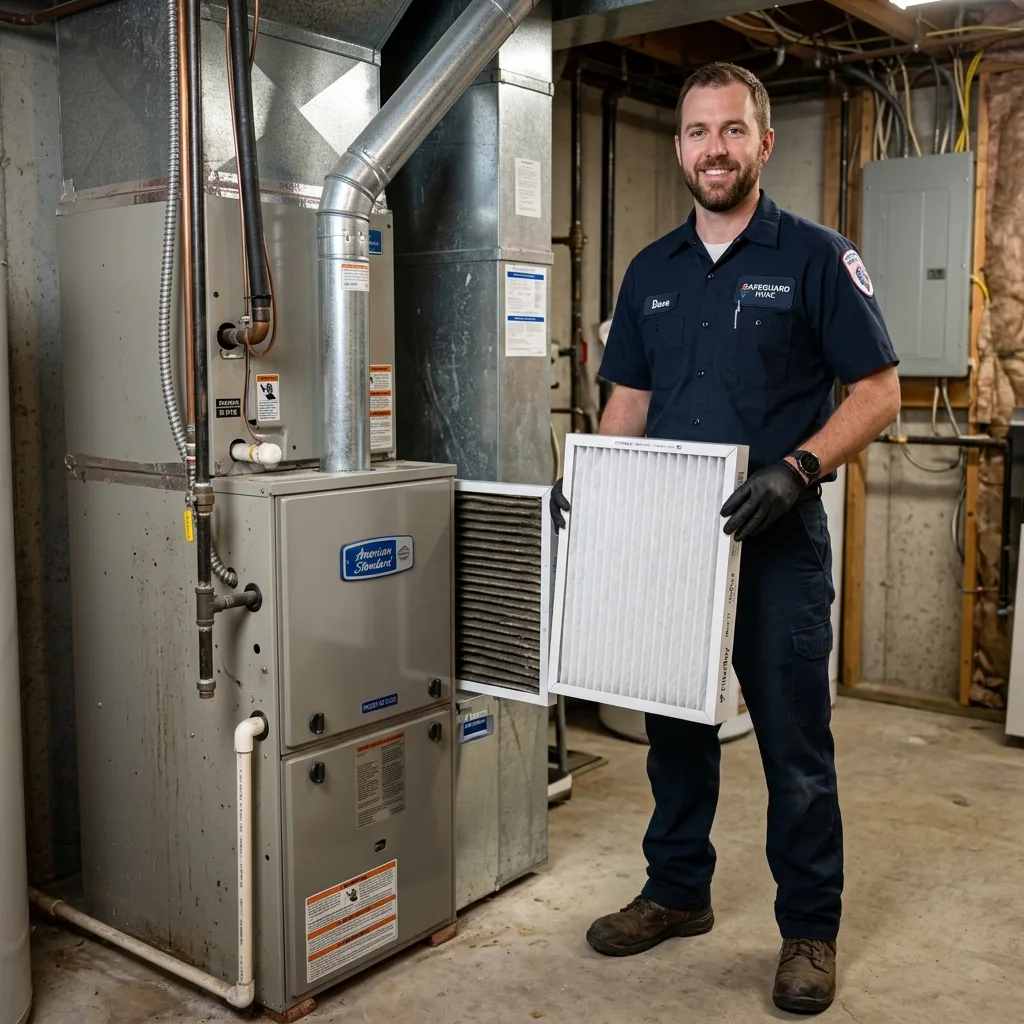
Filter intervals are a separate schedule from professional service and are the item homeowners control directly. A one-inch pleated filter during the Colorado Springs heating season typically needs replacing every 30 to 60 days, and closer to 30 in homes with pets, nearby construction or wildfire smoke exposure. A four-inch media filter usually runs six to twelve months. Changing on schedule rather than on appearance matters, because restriction develops before the filter looks dirty.
Equipment age shifts the calculation. Under about eight years, annual service is generally sufficient for a correctly derated furnace at city elevation. Between eight and fifteen years, twice-yearly service becomes worthwhile because the components most likely to fail — inducer motor, blower capacitor, igniter, flame sensor, pressure switch — begin drifting out of specification. Beyond fifteen years, the inspection increasingly becomes a repair-or-replace assessment rather than routine upkeep.
Skipping maintenance rarely causes a dramatic immediate failure. What it causes is drift: manifold pressure moves slightly off target, the flame sensor signal weakens, static pressure creeps up as filters are changed late, and temperature rise climbs toward the top of its band. Each change is individually harmless. Together they shorten heat exchanger life, raise gas consumption and eventually produce the mid-January no-heat call that maintenance was meant to prevent.
A practical rule for the Pikes Peak region: at Colorado Springs elevation, with equipment under eight years old and a four-inch media filter, annual autumn service is appropriate. Above 7,000 feet, or with equipment over eight years old, or in a household with pets and one-inch filters, move to twice yearly — once before the heating season and once at mid-season. Propane-fired properties in Black Forest and Cascade should default to twice yearly regardless of age, because propane systems are less tolerant of orifice and pressure drift.
Timing matters as much as frequency. The primary visit belongs in September or early October, before sustained cold and before the scheduling backlog. A mid-season visit, where warranted, is most useful in January when the furnace has accumulated enough runtime for drift to be measurable but enough season remains for a correction to pay for itself. Booking either in the middle of a cold snap means waiting behind genuine emergencies.
| Property Profile | Elevation | Recommended Interval | Primary Reason |
|---|---|---|---|
| Colorado Springs, unit under 8 yrs | ~6,035 ft | Annual, September–October | Standard derate and runtime |
| Cimarron Hills, Fountain, Stratmoor | 5,810–6,100 ft | Annual | Shortest local heating season |
| Monument, Gleneagle, Woodmoor | 6,890–7,150 ft | Twice yearly | Longer season, larger derate |
| Woodland Park, Black Forest | 7,100–8,437 ft | Twice yearly | Derate over 28%; extended runtime |
| Any property, unit over 8 yrs | Any | Twice yearly | Component drift accelerates with age |
Not sure whether your elevation and equipment age call for one visit or two? Tell us your neighbourhood and furnace age and we will give you a straight answer. Call 719-602-8787.
Direct Answer: Annually is the baseline at 6,035 feet for equipment under about eight years old. Properties above roughly 7,000 feet — Woodland Park, Black Forest, Monument, Woodmoor — benefit from twice-yearly service because of longer heating seasons and larger derating requirements. Equipment over eight years old should move to twice yearly at any elevation.
Direct Answer: The higher the property, the larger the mandatory derate and the longer the furnace must run to deliver the same heat. A Woodland Park furnace at 8,437 feet operates under a derate exceeding 33% across a season that starts earlier and ends later than Fountain's at 5,810 feet. Identical equipment in those two homes accumulates very different runtime.
Direct Answer: A one-inch pleated filter typically needs changing every 30 to 60 days during the heating season, closer to 30 with pets, nearby construction or wildfire smoke. A four-inch media filter usually lasts six to twelve months. Change on schedule rather than by appearance, because airflow restriction develops before the filter looks dirty.
Direct Answer: Rarely a sudden failure — usually drift. Manifold pressure moves off target, the flame signal weakens, static pressure creeps upward and temperature rise climbs toward the top of its band. Each change is harmless alone. Together they shorten heat exchanger life, raise gas consumption and produce the mid-winter no-heat call maintenance was meant to prevent.