
📅 Sep 28, 2025 · 9 min read
Furnace Maintenance Frequency Guide
Learn how high altitude, long heating seasons, and mountain runtimes impact how often your furnace needs professional maintenance.
How Often to Service a Furnace →Direct Answer: A furnace cleaning is a housekeeping visit — vacuuming the cabinet, wiping the burners, swapping the filter. A maintenance tune-up is a measurement visit: combustion analysis, manifold gas pressure, temperature rise, static pressure, microamp flame signal and a heat exchanger inspection. Only the second one produces numbers, and at 6,035 feet those numbers are the whole point.
The distinction matters because the two services are priced similarly and advertised almost identically. A cleaning improves how the equipment looks and removes dust that can foul the flame sensor. It does not tell you whether the furnace is burning correctly, whether the heat exchanger is intact, or whether the gas valve is delivering the right manifold pressure for your elevation. Those are the failures that shorten equipment life and produce carbon monoxide.
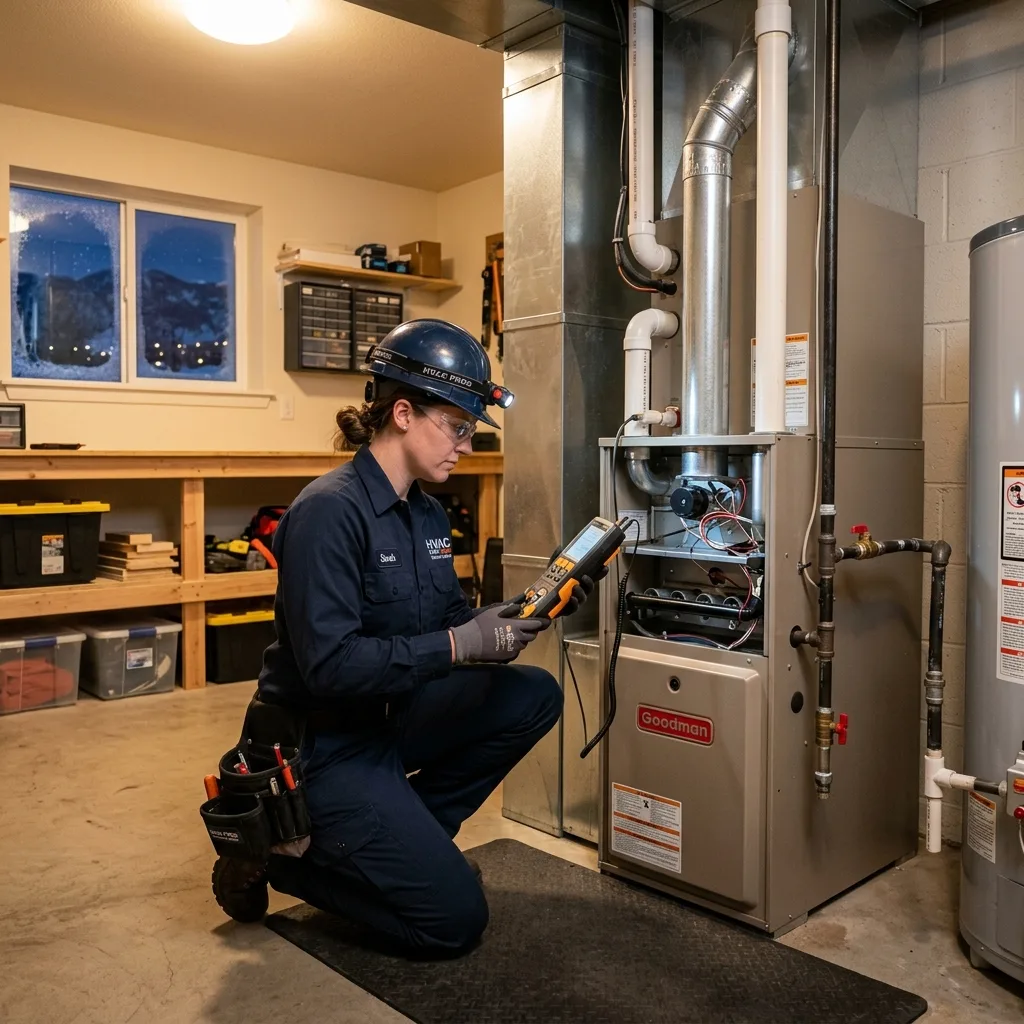
Combustion analysis is the single measurement that separates the two. A technician inserts a calibrated analyser probe into the flue and reads oxygen, carbon monoxide, stack temperature and calculated efficiency simultaneously. On a correctly derated furnace at 6,035 feet, those readings fall inside a known band. Readings outside that band indicate overfiring, insufficient combustion air, a restricted flue or a failing heat exchanger — none of which are visible to the eye, and none of which a cleaning would reveal.
A genuine tune-up should produce five recorded numbers: manifold gas pressure in inches of water column, temperature rise across the heat exchanger, external static pressure, flame signal in microamps, and flue-gas carbon monoxide in parts per million. If the invoice lists tasks performed but no measured values, what you purchased was a cleaning with a tune-up label on it.
Manifold pressure is where altitude enters directly. A furnace shipped from the factory is configured for sea level, and above 2,000 feet the input rate must be reduced roughly 4% per 1,000 feet. That is achieved with a high-altitude orifice kit and a gas valve adjustment. A furnace that has never been derated runs rich, deposits soot on the heat exchanger, and produces elevated carbon monoxide even while appearing to work normally.
Heat exchanger inspection is the safety item that justifies the whole visit. A crack in the exchanger allows combustion gases to mix with the air circulating through your home. Cracks are frequently invisible from the burner side and are found with an inspection camera, or inferred from a combustion analyser reading that spikes when the blower engages. A cleaning visit that does not include this inspection has skipped the one check that carries real consequences.
For a Colorado Springs household, the practical guidance is straightforward: ask what will be measured before booking, and ask for the readings afterwards. A reputable contractor will hand over a commissioning sheet with the numbers on it. Keeping those sheets year over year turns a series of unrelated visits into a trend line, and a heat exchanger temperature or CO reading that climbs slowly across three seasons is an early warning no single visit can provide.
A thorough annual service covers ignition and safety controls, gas train and combustion, airflow, electrical, and venting. In practice that means testing the hot surface igniter's resistance, cleaning and reading the flame sensor in microamps, verifying rollout and limit switch operation, confirming inducer draft through the pressure switch, measuring manifold pressure against the derated target, checking blower amp draw and capacitor value, and inspecting the vent run for slope, support and termination clearance.
The airflow half of the visit is just as important as the combustion half and is more often skipped. Temperature rise must land inside the band printed on the furnace data plate, commonly 40°F to 70°F. External static pressure should stay below about 0.5 inches of water column. When those two numbers are out of range, the furnace will eventually trip its high-limit switch regardless of how clean the burners are — which is why cleaning alone never resolves a short-cycling complaint.
| Service Element | Basic Cleaning | Full Tune-Up | Why It Matters in Colorado Springs |
|---|---|---|---|
| Cabinet and burner dusting | Included | Included | Prevents flame sensor fouling |
| Combustion analysis | Not included | Measured in flue | Detects overfiring and CO at altitude |
| Manifold gas pressure | Not included | Measured and adjusted | Confirms correct 4%/1,000 ft derate |
| Heat exchanger inspection | Visual at best | Camera or analyser-verified | Cracks leak combustion gas into the home |
| Static pressure and temp rise | Not included | Both recorded | Out-of-range values trip the limit switch |
Ask any contractor which numbers they will record before you book. Ours arrive on a commissioning sheet you keep — combustion, manifold pressure, temperature rise and static pressure. Call 719-602-8787.
Direct Answer: Cleaning is housekeeping — vacuuming the cabinet, wiping burners, changing the filter. Maintenance is measurement: combustion analysis, manifold gas pressure, temperature rise, static pressure, flame signal in microamps and a heat exchanger inspection. Only maintenance produces recorded numbers, and at 6,035 feet those numbers are what confirm the furnace is burning safely.
Direct Answer: Look at the invoice. A genuine tune-up lists measured values: manifold pressure in inches of water column, temperature rise in degrees, external static pressure, flame signal in microamps, and flue carbon monoxide in parts per million. An invoice that lists tasks performed but no readings describes a cleaning with a tune-up label on it.
Direct Answer: Furnaces leave the factory configured for sea level. Above 2,000 feet the input rate must be reduced roughly 4% per 1,000 feet using a high-altitude orifice kit and a gas valve adjustment. A furnace that was never derated runs rich, soots the heat exchanger and produces elevated carbon monoxide while still appearing to operate normally.
Direct Answer: Usually not. Short-cycling is most often an airflow problem — temperature rise above the rated band or static pressure over about 0.5 inches of water column — which trips the high-limit switch. Cleaning burners does not change airflow. The fix requires measuring both values and addressing the filter, ductwork or blower speed causing the restriction.